Qiai (Artemisia argyi var. qiai) Essential Oil: Benefits, Effects and Precautions for Use
What are the precautions to keep in mind when using Qiai essential oil?What are the effects and benefits of Qiai?
Precautions for Qiai essential oil:
(1) Pure essential oil must not be applied directly to the skin; it must first be diluted with a carrier oil before being applied to the skin.
(2) Essential oil should be sealed in a dark glass bottle and stored away from light and heat; otherwise its quality may be affected. (Qiai essential oils from "Ailian Aixi" are all packaged in high-quality, finely frosted bottles.)
(3) It is flammable, so do not place it over a fire or take it orally directly. When needed, only a small amount may be dropped into warm water and taken.
(4) Pregnant women and people with skin allergies should use it with caution.
(5) Pure essential oil must be kept away from the eyes to avoid burns.
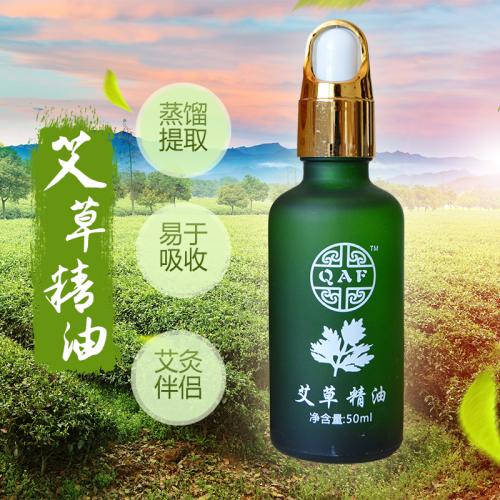
The effects and benefits of Qiai
Of Qiai it is said: "Taken internally, it travels through the three yin meridians and dispels all cold and dampness, turning harsh, killing energy into harmony; used as moxa, it penetrates all the meridians and treats a hundred kinds of pathogenic illness, raising the seriously ill to health and long life. Its merits are indeed great." Besides treating many diseases, Qiai also has a distinctive fragrance, and when its leaves and branches are burned as smoke they can drive away mosquitoes and flies and clear miasmic air, possessing the function of averting and killing toxins. Later research holds that Qiai has effects such as regulating qi and blood, dispelling cold and dampness, regulating menstruation and calming the fetus, warming the meridians and stopping bleeding, and clearing heat, relieving cough and reducing phlegm. It mainly treats irregular menstruation, cold pain in the abdomen, spotting during pregnancy, restlessness of the fetus, infertility due to uterine cold, and other conditions. It is one of the commonly used essential medicines in gynecology in traditional Chinese medicine. Taken internally it can serve as a hemostatic; when stir-fried into charcoal its hemostatic power is quite strong, and it can treat vomiting of blood and dysentery, as well as epistaxis and bloody stool. Taken as a pounded juice, it stops bleeding from injuries, kills roundworms, treats abnormal vaginal discharge, and stops the cramping of cholera and the chills and fever after dysentery.
Formulas containing Qiai can also treat chronic bronchitis, asthma, gastroenteritis, dysentery and other conditions in the elderly. Used externally, Qiai can treat skin itching, genital itching, eczema and scabies. Rubbing the hands with moxa to wash away grime, or decocting it in water for a bath, can help prevent and treat skin diseases. For mothers in confinement and infants, washing with mugwort leaves can disinfect and strengthen the body. The leaves are sun-dried and pounded into a fluff known as "moxa floss", which is made into moxa cones and burned at acupuncture points, or dipped in sesame oil to light and ignite the moxa cones, soothing moxa sores until they heal without pain.
Moxibustion has remarkable effects in treating illness: it can disperse cold and remove dampness, warm and unblock qi and blood, and free the meridians and invigorate the collaterals. Thus physicians say that moxa can be used in moxibustion for a hundred diseases (from the "Record of Famous Physicians"), and it is called "moxa herb". Each burning of moxa is called "one zhuang". Qiai not only treats many diseases but also has a distinctive fragrance, so it can be used as a raw material for blending fragrances. When its leaves and branches are burned as smoke they can drive away mosquitoes and flies, and have the effect of averting toxins and sterilizing. "Willow on Qingming, mugwort on Duanwu" - the people of Qichun even regard Qiai as more fragrant than ordinary mugwort, with better curative effects when used as medicine to treat illness.