What are the symptoms on leaves when a plant lacks water versus when the soil is too wet?
Leaf symptoms of water deficiency and waterlogging in plants. The plant's roots are healthy but the soil moisture is insufficient, and the leaves are constantly losing water through transpiration. This is especially likely to happen to newly planted seedlings in autumn when there is no rain, strong wind, and blazing sun. Especially for newly planted seedlings in autumn.
Water deficiency in plants and the leaf symptoms of waterlogging.The plant's roots are healthy but the soil moisture is insufficient, and the leaves are constantly losing water through transpiration. This is especially likely to happen to newly planted seedlings in autumn when there is no rain, strong wind, and blazing sun. Especially for newly planted seedlings in autumn, watering at least once a day is the safest. There are mainly three situations for leaf symptoms of water deficiency in plants:
1. Young shoots, leaves and leaf stalks become soft and drooping. For example, jackfruit, star apple, passion fruit, kiwi, and kei apple, etc. As long as the plant has not reached the permanent wilting point, water immediately upon discovering this situation, and usually after 2~3 hours the soft and drooping parts will become firm again. This kind of soft drooping of branches and leaves caused by water deficiency is very easy to identify.
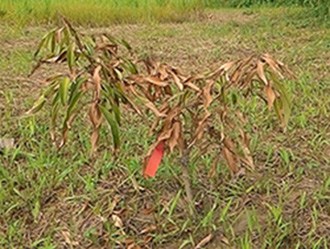
2. Leaves scorched yellow, crisp and brittle. For example, wax apple, lychee, rambutan, and jacaranda, etc. When these are short of water, the branches and leaves do not droop. The leaves and leaf stalks remain firm throughout, and the leaves rapidly turn dry and scorched within a few hours. This is caused by water deficiency plus one or several damaging factors among blazing sun, high temperature, or dry strong wind. Although watering immediately upon discovering this situation cannot restore the appearance of the leaves, as long as the permanent wilting point has not been reached, the plant will still continue to grow after new buds sprout and old leaves fade and fall. # The following four examples have one thing in common, namely that the leaves remain firm and dry up from the bottom upward. This indicates that the seedling's roots are healthy and the physiological cycle is normal (no root rot, no drooping leaves). The leaf scorch is caused by rapid air-drying under water deficiency. Please look at this photo of jacaranda: the terminal buds are still green, the lower leaves are all withered, and the withered leaves still remain firm.
3. Young leaves shrink, but the branch tips do not droop. For Rosaceae trees such as plum, plumcot, apricot, cherry, peach, and Japanese apricot, when water deficiency reaches the point where young leaves appear wrinkled, even watering immediately is already too late. At this time the branch tips are still plump and firm, but after one or two days longitudinal shrinkage lines appear on the branch tips and gradually spread downward. For grafted seedlings, in mild cases only the branches with shrunken young leaves dry up; in severe cases the entire scion part is damaged and dies; and in the most severe cases even the rootstock dies along with the whole plant. Therefore, when Rosaceae trees are first planted, water deficiency must be carefully guarded against (watering at least once a day). In the early stage of this kind of water deficiency there are no leaf symptoms, and watering immediately can remedy it, but if water deficiency reaches the critical point (young leaves shrinking), it often gradually dries up downward and finally the whole plant dies, so this must not be taken lightly.
[Waterlogging]
If the potting soil or ground soil of seedlings is often moist, this cannot yet be called waterlogging, but when there is so much water that roots rot, then this is waterlogging. If the roots are unhealthy, the leaves must show signs. As the saying goes, when the roots are sound the seedling is vigorous; when the roots are strong the leaves are necessarily firm and glossy, while root rot causes the plant to show "frequent" drooping branch tips, dull leaves, and soft, collapsed texture. Figure 1 below shows the situation of excessive water and root rot, and Figure 2 shows a comparison of the leaf characteristics of healthy roots (left) and rotted roots (right).
Note:
1. How do you distinguish soft drooping caused by waterlogging from the soft drooping of branch tips caused by water deficiency (item 1 above)?
Soft drooping caused by water deficiency becomes firm again a few hours after watering, and is temporary soft drooping. Soft drooping caused by waterlogging and root rot cannot recover by watering, and the branch tips show a frequent soft drooping phenomenon.
2. After seedlings with root rot have their leaves exposed to long hours of blazing sun, will the phenomenon of scorched yellow, crisp and brittle leaves appear (item 2 above)?
As long as the degree of root rot has not reached death, even after long hours of blazing sun the leaves will still be green, only the leaf color is on the pale side, light green or pale yellow, along with dull leaves and a soft, collapsed texture.