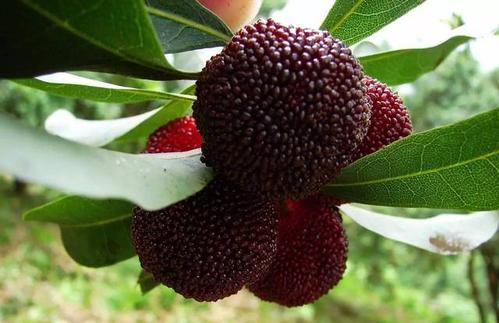
Introduction to Sweet Waxberry Varieties: Cultivation Characteristics of Ruiguang Waxberry and Dongkui Waxberry, How Many Years Until They Bear Fruit
Do you like eating waxberries? Then would you like to know about the cultivation characteristics of Ruiguang waxberry and Dongkui waxberry? Let's take a look together! Ruiguang waxberry was introduced from Japan, and its fruit is the size of a fifty-yuan coin, making it the large-fruited variety second only to Dongkui in Taiwan, China. Although all waxberries have some tartness
Do you like eating waxberries? Then would you like to know about the cultivation characteristics of Dongkui waxberry and Ruiguang waxberry? Let's take a look together!
Ruiguang waxberry was introduced from Japan, and its fruit is the size of a fifty-yuan coin, making it the large-fruited variety second only to Dongkui in Taiwan, China. Although all waxberries have some tartness, its fully ripe purple fruit has excellent sweetness, with a sugar content of 13. In both fruit shape and flavor, it far surpasses other Japanese waxberry varieties. The plant is very productive, with the production period two weeks after Qingming, and the harvest period can reach 15 days. The fruit has excellent storage tolerance, remaining fresh after 5 days of low-temperature refrigeration. The plant is highly adaptable and vigorous, resistant to wind, heat, cold, drought, and poor soil. This variety has no so-called male tree; a single plant will bear fruit, and no pollinator tree needs to be configured for planting. It bears fruit 3 years after planting.
Ruiguang waxberry was introduced from Japan, and its fruit is the size of a fifty-yuan coin, making it the large-fruited variety second only to Dongkui in Taiwan, China. Although all waxberries have some tartness, its fully ripe purple fruit has excellent sweetness, with a sugar content of 13. In both fruit shape and flavor, it far surpasses other Japanese waxberry varieties. The plant is very productive, with the production period two weeks after Qingming, and the harvest period can reach 15 days. The fruit has excellent storage tolerance, remaining fresh after 5 days of low-temperature refrigeration. The plant is highly adaptable and vigorous, resistant to wind, heat, cold, drought, and poor soil. This variety has no so-called male tree; a single plant will bear fruit, and no pollinator tree needs to be configured for planting. It bears fruit 3 years after planting.
Dongkui waxberry originated in Zhejiang, mainland China, and is an excellent variety resulting from variation in a seedling plant. It has a history of more than 100 years and was named Dongkui in 1970. Although its fruit quantity is slightly lower than that of Ruiguang (sweet waxberry), its fruit is the largest waxberry variety in the world. The ripe fruit is purple-red, with an average weight of 23 grams, as large as a ping-pong ball, and a sugar content of 13. It is sweet and tart with a particularly excellent flavor. The production period is after Qingming, and the harvest period reaches 16 days. A mature tree bears 50 kg of fruit per plant. The plant is resistant to wind, heat, cold, drought, and poor soil. This variety has no so-called male tree; the plant bears both female and male flowers at the same time, and no pollinator tree needs to be configured when planting. It can bear fruit 3 years after planting.
Waxberry is a very easy fruit tree to grow. In Japan, it is mostly used as a landscape or street tree and is often seen in parks, but most are small-fruited varieties. In Taiwan, China, because the production season is short (May to June), it is mostly cultivated in scattered plots, and it is almost never seen for sale on the market, with prices relatively high (about 200-300 yuan per jin). Early varieties were mostly small-fruited types with no commercial value, and later some large-fruited varieties were gradually introduced. The main varieties currently in circulation are Dongkui, Ruiguang, and Heitan. Dongkui has the largest fruit but low yield (the size of a 50-yuan coin), while Ruiguang and Heitan are slightly smaller but have abundant yields.
If growing in a pot, it is recommended to plant it in a one-and-a-half-chi pot, and it will probably bear fruit in 2-3 years. The seedlings are all grafted seedlings, so a single plant can bear fruit. Together with figs, it is one of the must-grow fruit trees for home gardening! Field planting observations show that aside from scarab beetles gnawing on the leaves, there are almost no pests or diseases, and when fruiting, netting is needed to prevent birds from pecking.