What are the characteristics and uses of the bayberry tree (Morella rubra), and how many years does it take to bear fruit when grown from seed?
In Taiwan, China, bayberry production areas are mostly found on low-elevation hillsides in the central and northern regions, and the harvest season is mostly around the Qingming Festival in spring. There are many varieties of bayberry; the main cultivated varieties include wild bayberry, button bayberry, red bayberry, pink bayberry, snow bayberry, and black bayberry. Do you know how to grow a bayberry tree? Why not first take a look at the introduction to the characteristics of the bayberry!
‧Place of origin: South of the Yangtze River in mainland China, in Guangdong and Guangxi, Fujian, Hunan, and Zhejiang, as well as Japan, South Korea, the Philippines, and Taiwan, China, where it grows wild or is cultivated.
‧Distribution: Distributed on mountain foothills in Taiwan, China at elevations of 300~1500 m.
‧Uses: 1. For horticulture, street trees, and hedges: it is highly robust, grows slowly, has a beautiful tree form, and is drought- and barren-tolerant, making it suitable as a street tree, landscape tree, bird-attracting tree, or hedge. 2. Food: eaten fresh, it promotes salivation and quenches thirst, and it can also be made into candied fruit or jam. 3. The bark contains abundant tannins, which can be extracted; it can also be used medicinally. 4. Wood uses: the sapwood is broad and grayish white, the heartwood is narrow and pale yellowish brown, the annual rings are indistinct, and the wood is dense and relatively hard, mostly used for farm tools or various utensils. 5. Medicinal: bayberry has the effects of relieving excessive thirst, harmonizing the five viscera, cleansing the stomach and intestines, and eliminating foul qi, and it has a certain therapeutic effect on symptoms such as deficient fire flaming upward, thirst with irritability and heat, and gastrointestinal discomfort. Nature and flavor: root and bark: bitter, warm; fruit: sour, sweet, neutral. Effects: root and bark: dissipate blood stasis, stop bleeding, and relieve pain. Treats vomiting blood, profuse uterine bleeding, hemorrhoidal bleeding, traumatic injuries, fractures, gastric and duodenal ulcers, enteritis, dysentery, and toothache; fruit: promotes salivation and quenches thirst. Treats dry mouth and poor appetite; an appropriate amount of root bark is ground into powder and sprinkled on or mixed with cooking oil and applied to the affected area to treat traumatic bleeding, burns, and scalds.
‧Stem: A tree up to 20 m tall, with a trunk diameter of 60~100 cm, a straight trunk, and grayish brown, smooth bark, with many branches; the branches rise obliquely or extend horizontally, slightly pubescent or smooth and hairless when young, becoming smooth and hairless when old.
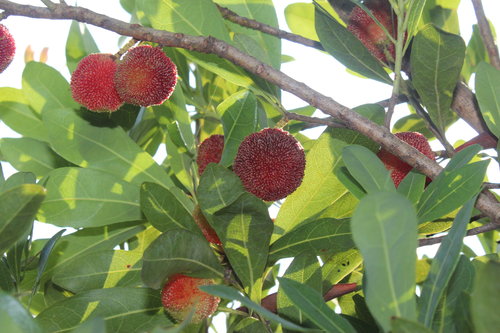
‧Leaves: The leaves are simple, alternate, mostly spirally arranged and clustered at the tips of the branches, long obovate or obovate-lanceolate, 5~9 cm long, sometimes up to 15 cm, 2~2.5 cm wide, sometimes up to 3.5 cm, with an obtuse or acute tip and a gradually narrowed or wedge-shaped base; the upper half of the leaf margin is mostly sparsely serrate, semi-leathery, slightly glossy green on the surface and pale green on the underside, with the midrib, lateral veins, and veinlets raised on both surfaces; the petiole is short, 1~2 cm long, smooth and hairless, with groove lines.
‧Flowers: The flowers are unisexual and dioecious; the male flowers are numerous, in upright catkins arranged in spikes; the inflorescence is 5~9 cm long, bright red or nearly bright red; there are no calyx or petals, but there are 2 bracts and 3~4 bracteoles; the bracts are ovate-triangular, 0.4~0.5 cm long, with an acute tip, and the bracteoles are very small; there are 6~8 stamens, with filaments free or partly connate, appearing as if branched; the anthers are elliptical, 0.1~0.15 cm long; the female flowers are numerous, arranged on shorter spike-like inflorescences, usually with only 1~2 pollinated and setting fruit; the bracts and bracteoles are the same as in the male flowers; the ovary is ovate or round, often surrounded by many bead-like small protuberances, 1-locular; the style is very short, with a 2-parted stigma at the tip, the stigma broadly linear, 0.6~0.7 cm long, with fine hairs. Flowering period March~May.
‧Fruit: The fruit is a drupe, spherical or elliptical, 1.5~2 cm in diameter, sometimes up to 3 cm, densely covered on the outside with fine tubercles formed by numerous sac-like bodies; it is initially blue-green and bright red when ripe; the ripe fruit is covered with sac-like bodies, very juicy, sweet and sour, aromatic, tasty, and edible, and wild birds also like to eat it; it can be eaten fresh or made into candied fruit; there is 1 seed, upright, slightly similar in shape to a peach kernel; the ripening period is about May~July.
‧Characteristics: An evergreen tree with gray bark and stout branchlets. Leaves alternate, densely clustered at the branch tips, petiole 2~10 cm long, leaf blade leathery, obovate or long obovate-lanceolate, 5~15 cm long, 1~4 cm wide, base narrowly wedge-shaped, tip obtuse, margin entire or with indistinct sparse obtuse teeth near the upper end, dark green on the upper surface and pale green on the underside, hairless on both surfaces, with golden-yellow glands. Flowers dioecious; male inflorescences several, clustered in the leaf axils, cylindrical, about 3 cm long, yellow-red, with 1 bract and 2~4 ovate bracteoles; stamens 5~6; female inflorescences ovate-long-elliptical, about 1.5 cm long, solitary in the leaf axils, with bracts and bracteoles at the base of the flowers; ovary ovate, style very short, 2-parted. Fruit a drupe, spherical, 1~1.8 cm in diameter, with papillate protuberances, dark red or purplish red when ripe. Flowering period March~May. Fruiting period April~June. Li Shizhen's "Compendium of Materia Medica" says it is "shaped like a water poplar seed, but its flavor resembles a plum," hence it is called bayberry. Bayberry has strong adaptability and prefers sunny places with good drainage. It is a famous fruit tree in our country; the fruit is round, bright red when ripe in summer, eaten fresh to promote salivation and quench thirst, and can also be made into candied fruit, jam, and so on; it is extremely suitable for planting in gardens for ornament and to attract birds. Propagation is by sowing or cuttings, with spring and autumn being more suitable.
Propagation:
Bayberry is generally propagated by seed, but it grows slowly; seedling plants that have not been grafted need more than 10 years to bloom and bear fruit. The bayberry tree has a graceful shape, and its leaves are green and glossy, making it suitable as an ornamental garden tree; spring is the more suitable time for planting out.
There are many varieties of bayberry, and the flavors differ considerably; some varieties taste sweet and are suitable for fresh eating, while some varieties have small, sour fruit and are mostly used as material for processing and pickling to make dried bayberry. When selecting fresh fruit, those with bright color and moderate ripeness are the best.
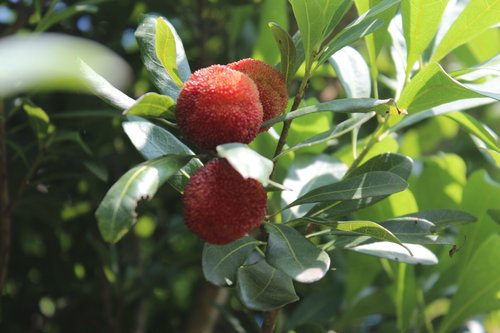
Nutritional composition: water 83.4%, protein 0.7%, fat 0.2%, carbohydrates 8.5%, fiber 0.3%, ash 0.4%, calcium, phosphorus, iron, vitamin A.
Bayberry is dioecious, but it is very difficult to tell from appearance whether it is a female plant or a male plant, and its growth period is also very long (it takes 7~10 years to bloom and bear fruit); only when it blooms can you know whether it is a female plant. Male plants only bloom and do not bear fruit - male flowers.
In addition to the need to plant both female and male plants of bayberry at the same time, dioecious fruit trees also require special attention to the fact that the flowering periods of the female and male plants must be very close, or even occur at the same time; if the female plant blooms first and the male plant blooms only after the female plant has finished flowering, then all the effort is completely wasted. If, due to space constraints, only one bayberry can be grown, it is recommended to grow a female plant, and during the juvenile stage it is recommended to graft a male bud shoot onto one of the branches, so that the female plant bears a male branch bud shoot; then when the female plant blooms, pollination can be provided, and only then can it set fruit.
Some characteristics of bayberry need to be explained: it is an evergreen tree that can grow to 15-20 m tall, blooms in February-March, and its fruit ripens around April-June. If pruning is needed, care must be taken, because the flowering and fruiting branches of bayberry bloom only after the new branch has grown for two years, not on the current year's branch; therefore, it must not be pruned indiscriminately, so as to avoid the phenomenon of bearing no fruit at all.