Farmers in Heze, Shandong Find Ever-Wider Paths to Prosperity
Introduction: The Huang-Huai River basin is the main summer corn producing region in China. Although corn prices have fallen, it is impossible to substantially reduce the corn area in the short term. The Heze Regional High-Tech Agricultural Science Research Institute has actively explored the model of interplanting autumn potatoes in summer corn and achieved abundant results. In 1999, 3,500 mu were promoted across the region, increasing income by nearly 10 million yuan.
The Huang-Huai River basin is the main summer corn producing region in China. Although corn prices have fallen, it is impossible to substantially reduce the corn area in the short term.
The Heze Regional High-Tech Agricultural Science Research Institute has actively explored the model of interplanting autumn potatoes in summer corn and achieved abundant results. In 1999, 3,500 mu were promoted across the region, increasing income by nearly 10 million yuan. In the Yangtze River and Huang-Huai River basins, because summer and autumn temperatures are high, potato cultivation is mostly based on spring planting. Autumn cultivation is technically demanding and difficult. Previously, the yield per mu was only about 500 kg, so the area of autumn-planted potatoes was small, and the time to market was December to January. In addition, because their commercial quality is better than that of Northeast potatoes, the selling price is generally 0.50-0.80 yuan per 500 g, and they sell very well.
Intercropping and interplanting potatoes with corn does not reduce corn yield, and in the early stage it also shades and cools the potatoes, which helps ensure a full stand of seedlings. It is a relatively good model for developing high-efficiency agriculture in the Huang-Huai River basin.
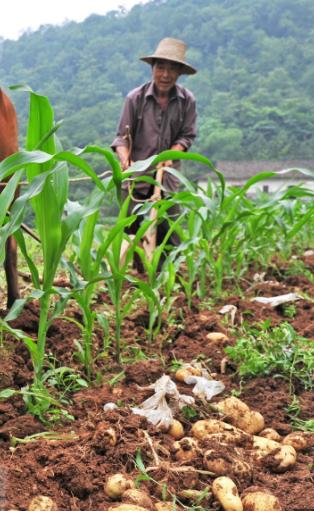
1. Select excellent varieties. For corn, it is advisable to choose Yuyu No. 22, which has high yield, large ears, and is suitable for sparse planting. Under the condition of 2,200-2,600 plants per mu, this variety can still reach a yield of 500 kg per mu. For potatoes, choose Lu Yin No. 1, Holland 15, Jinshu No. 8, etc., which have a short dormancy period.
2. Sow at the appropriate time. Corn should be sown early at the appropriate time, or interplanted in wheat fields, to promote corn harvest around mid-September, and the potato sowing period can be advanced to early August.
3. Interplanting method. Corn row spacing is 90 cm, plant spacing is 25 cm-30 cm; potato row spacing is 60 cm, plant spacing is 20 cm, with 5,000-5,500 plants per mu. Use 175 kg-300 kg of seed potatoes per mu.
4. Points for attention
1. The selected potato seed must be harvested around May 10, so that the potatoes can naturally pass through a dormancy period of about 90 days, ensuring a full stand after sowing. Autumn potatoes must be sown as whole tubers, and cutting into pieces and pregermination must be strictly avoided. Before sowing, whole tubers can be soaked for 10 minutes in a 600-fold carbendazim solution, which has a good sterilization and disinfection effect.
2. Choose relatively dry sandy loam soil for planting, and avoid waterlogged lowlands and ponding areas. After sowing, grass can be spread over the beds. After the corn is harvested, the temperature turns cooler, and the potatoes enter the middle growth stage, so they should be watered and fertilized frequently. The harvest period is selected 3-5 days after the first frost. Where conditions permit, protective measures can be used for covering, taking advantage of the relatively warm early winter temperatures to allow the potatoes to continue growing, which can significantly increase yield.
3. Pests and diseases are important factors affecting the stable development of potato production and limiting increases in unit yield. Potato diseases number more than 100 kinds, generally causing a 10-30% yield reduction, and in severe cases more than 70%. There are 15 common diseases in China, among which late blight, ring rot, and viral diseases are collectively called the "three major diseases." For more questions related to planting and breeding, you can consult experts on the Yunzhongyang platform. It has become the world's largest agricultural technology Q&A website. It brings together hundreds of thousands of experts in planting and breeding, ensuring that every question raised receives a response within 2 minutes.
For more professional agricultural science and technology information, please scan the QR code to follow WeChat: NongXunNET

Please indicate the source when reprinting.