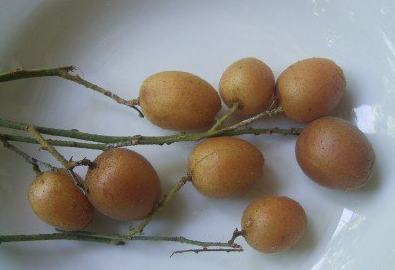
Are Seedless Wampee Fruits Really Seedless? A Full Breakdown of Their Characteristics, Advantages and Taste
Many people find that seedless wampee fruits turn out to have seeds, and that was the case for me at first too.
This time, because of the unusual weather last winter, only one of my four or five wampee varieties flowered and set fruit, and it later turned out that this one really is seedless.
Last year the same tree set fruit with many seeds, for the reasons below.
When seedless wampee is pollinated by different wampee varieties, including different varieties of seedless wampee, it will all turn seedy. So as long as different wampee varieties, including seedless ones, are planted nearby and flower at the same time and cross-pollinate, seedless wampee will lose its seedless trait and become seedy. In the past I wrongly blamed the seedling sellers.
The reason is that grafted plants from seedy stock will not produce seedless fruit. In the past, each of my trees would occasionally have two or three seedless fruits, which means those two or three fruits were individuals that had not been cross-pollinated. The same tree, when it fruited last year, had only two or three seedless fruits and a high fruit-setting rate, while this year it bore only a sparse few, and every one of them was seedless.
It also confirms that seedless wampee has a low fruit-setting rate when self-pollinated, that seedless wampee cannot be planted adjacent to other varieties, and that with its low fruit-setting rate it is not suitable for commercial production and is only suited to hobby growing. Unless cheap isolation equipment is used during the flowering period, which can improve it slightly. If you do not mind the seeds, it is very much worth growing.
This is an ancient fruit, grown in the Yunnan, Guangxi, Guangdong and Fujian areas of mainland China.
A small tree of the Rutaceae family.
The fruit is edible and medicinal; the leaves can be used for washing hair or as a hair tonic for baldness; unripe fruit or roots, cut fine and dried in the sun, serve as a treatment for bronchitis. The flesh is eaten raw, or the juice is mixed with sugar water as a fever-reducing refresher.
It is mainly divided into two lines, sour and sweet. Fully sour and semi-sweet-sour are both classified as the sour line, while the sweet line is not sour at all. I prefer the large-fruited sweet-sour varieties, which are moderately sweet and sour when ripe.
In the early days, some people in eastern Taiwan, China grew small-fruited sour-line varieties.
At present, hobbyists in Taiwan, China are growing seedless large-fruited varieties. Because this is an ancient fruit, the native species in its place of origin has naturally reproduced for countless generations, producing countless variations, and keen-nosed people in Taiwan, China noticed the differences and introduced them.
In fact, its seeds are shrunken and undeveloped, a triploid condition.
It goes against nature by giving up its offspring, and a genetic variety like this would become extinct without human intervention.
Humans, too, out of their own preferences, deliberately alter plant genes to make them disease-resistant, high-yielding, larger and seedless.
The more unscrupulous corporations modify plant genes so that only seeds and fertilizers produced with their patented formulas can give high yields, leaving farmers around the world led around by the nose by them.