Pineapple Sugar Apple Cultivation Management Techniques and Harvesting Methods
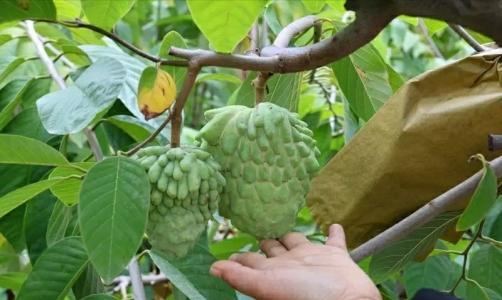
Few people have heard the name of the fruit pineapple sugar apple, and even fewer have tasted its flesh. It differs from the sugar apple grown in Taitung in both fruit shape and taste. The pineapple sugar apple is sour, sweet, and chewy, with a very unique texture, especially noticeable during droughts in the plum rain season.
When I bought farmland over a decade ago, the pineapple sugar apple was at its peak. As a new and emerging fruit, the retail price was over 100 yuan per Taiwan catty, making it a high-value crop. But good times did not last; within just a few years, the rapid increase in planting area led to overproduction, and the retail price (mid-range) dropped to only around 30 yuan per Taiwan catty. The output value was lower than growing other fruit trees such as peaches and loquats. Moreover, with cultivation techniques for immature fruit cracking, maturity was hard to control, leading to excessive unsold stock for vendors. These problems could never be overcome. In recent years, I have heard from farming friends that a large area has been abandoned or cut down and converted to other vegetables and fruits, so the quantity on the market now is very small.
The pineapple sugar apple sheds its leaves in winter. Before bud break and differentiation in spring, it needs pruning. Branches that are too thin should be cut off, and “fruiting branches” should be kept at about half a Taiwan foot to one Taiwan foot (depending on branch thickness). Each “fruiting branch” will eventually bear one fruit. How many “fruiting branches” to keep naturally depends on personal experience; keeping too many will of course make the fruits smaller. After flowering and fruiting, about 20 leaves should be retained and the tips pinched. Non-fruiting “fruiting branches” can be cut back to one Taiwan foot, and the last three leaves removed, so they will flower and fruit again.
To prevent fruit flies, I mostly hang yellow sticky boards, and when the fruits are about one inch in size, I bag them with plastic bags. Later, if cotton aphids become severe, I remove the bags so that their natural enemy, the Japanese white-eye, can come and act as the cleaner.
For pollination of the pineapple sugar apple, nocturnal moth pollination saves the most labor, but sometimes pollination is incomplete, so the fruit does not grow large and the fruit shape is not attractive. Ordinary tenant farmers use pesticides, and the ground is also sprayed with herbicides, leaving it bare, so there are simply no nocturnal moths available for pollination. Therefore, hand pollination has to be used, and hand pollination also has benefits, such as attractive fruit shape. For pesticide-free cultivation, insect pollination plus hand pollination is of course foolproof, but I am not that hardworking... natural is still best.
Harvesting the pineapple sugar apple is also a major skill. It requires correctly judging its maturity. If it is not ripe enough, during later ripening it will turn black and hard and become inedible. If it is too ripe, it will crack on the tree or fall off. After harvest, the fruit should be kept at room temperature to ripen. For example, if placed in cold storage, it may fail to ripen. After ripening, it will crack, and the skin will become soft, black, or brown. When eating, cut it open with a knife; the flesh is white, and the skin and seeds are not edible. If there is more than you can finish, it can be refrigerated. If peeled, seeded, and frozen, it can be blended into juice without thawing, making a pineapple sugar apple smoothie. In recent years, although the cultivation techniques for the pineapple sugar apple have not improved much, for pesticide-free cultivation, the harvested quantity and quality are better than before, which is worth taking comfort in.
Postscript: Because its sweetness is very high, eaters worry about gaining weight, and its nutritional value has never been published. I hope a research institution can study and publish its nutritional value.