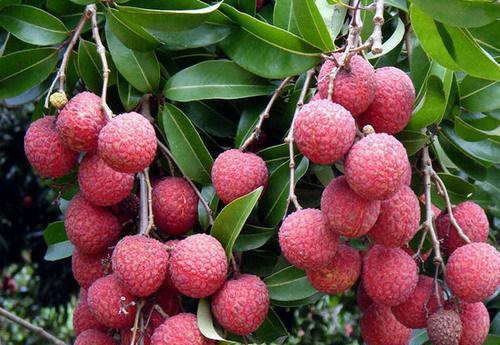
Rational Fertilization Methods for Lychee Orchards and Factors to Consider
Lychee cultivation is fairly widespread, and many regions have lychee orchards. So precautions for lychee cultivation how should rational fertilization in lychee orchards be carried out,what issues need to be considered, let's take a look together!
Rational fertilization in lychee orchards must take the following factors into consideration:
(1) Growth habits of lychee
Among nutrient elements, nitrogen is the main component of protein in plants and has the greatest relationship with leaf and shoot growth; phosphorus is an important element for promoting flowering; appropriate potassium can inhibit the sprouting of branches, and potassium is also related to the increase in sugar content in the later stage of fruit development; calcium is a structural component of cell walls and has an obvious relationship with fruit cracking; as for magnesium, it is a component of chlorophyll, and when deficient, branches become smaller and fruit sugar content is low. Therefore, although plants need nitrogen, phosphorus, potassium, calcium, magnesium and other nutrient elements at all growth stages, generally speaking, after fruit harvest, rapid growth of branches and leaves is desired, so heavier nitrogen and magnesium fertilizers are needed; in autumn and winter, lychee branches need to stop growing to smoothly enter flower bud differentiation, so phosphorus and potassium fertilizers are more needed; fruit development and enlargement and ripening also emphasize phosphorus and potassium fertilizers; as for varieties prone to fruit cracking such as Nuomici, calcium fertilizer should be sprayed during fruit development to prevent fruit cracking. Since calcium and magnesium are required by plants in smaller amounts, this article focuses more on the application of nitrogen, phosphorus and potassium fertilizers.
(2) Characteristics of nitrogen, phosphorus and potassium elements in soil
Nitrogen moves quickly in soil and can quickly move to the root surface to be absorbed by plants, but it is also very easily lost; phosphorus moves very slowly in soil and is easily fixed by iron, aluminum, etc.; potassium's movement rate is between the two. Therefore, when fertilizing, nitrogen and potassium fertilizers should be applied in multiple split applications, while phosphorus fertilizer is best applied in only 1-2 split applications. When applying, furrow application mixed with organic fertilizer is preferable to help it move to the root surface sooner.
(3) Soil acidity and alkalinity (i.e. pH value)
Lychee grows best in soil with a pH of 5.5-6.5, but among the total farmland soil area in Taiwan, China, soils with pH below 5.5 account for 32%. Therefore, quite a few lychee orchards belong to this type of strongly acidic soil. In strongly acidic soil, phosphorus is often easily fixed, and calcium, magnesium and boron are prone to deficiency; in addition, aluminum has low solubility and can easily cause toxicity to plants. Such soil should be improved by applying lime. The lime commonly used in orchards is dolomitic lime CaMg(CO3)2. Lime should be applied in small amounts multiple times for gradual improvement; do not apply excessive lime all at once. The amount of lime varies with pH value. General reference amounts are: for soil at pH 5.5-5.0, apply 40-80 kg per fen; for pH 5.0-4.5, apply 80-120 kg per fen; for pH 4.5-4.0, apply 120-160 kg per fen. The application method is to spread it evenly together with organic matter after fruit harvest, and it is necessary to plow the soil to 0-30 cm, then sprinkle water to keep the soil moist.
(4) Variety characteristics
Among lychee varieties, Yu Her Pau has the strongest growth vigor, long flower panicles, and the largest number of florets, and therefore has higher fertilizer requirements than other varieties.
(5) Fertilization methods
Based on the above principles, lychee fertilization can adopt the following methods:
1. After fruit harvest and before pruning, fertilizer should be applied. The amount includes 2/3 of the annual nitrogen fertilizer, 1/2 of the annual phosphorus fertilizer and potassium fertilizer. The application method is to open furrows along the east-west or north-south direction around the canopy or open radial furrows, apply the required fertilizer, and cover with soil. For late-maturing varieties or central mountainous areas, fertilization can be considered two weeks before harvest to avoid late fertilization causing the sprouting of winter shoots. This fertilizer application should preferably be completed before the end of June.
2. At the stage after flowers fade and fruit set, another fertilization should be applied. The amount includes 1/3 of the annual nitrogen fertilizer, 1/2 of the annual phosphorus fertilizer and 1/4 of the annual potassium fertilizer. The application method is to clear the leaves or branches under the canopy, then spread evenly.
3. At the early stage of fruit coloring, spread the remaining 1/4 of the potassium fertilizer evenly under the canopy, and combine with foliar spraying of comprehensive trace elements, which can increase sugar content and improve coloring.
At present, many farmers commonly use compound fertilizers. Compound fertilizers are difficult to apply according to the above methods, but the key points are similar. After fruit harvest and before pruning, Taiwan Fertilizer No. 43 should be applied in furrows; after flowers fade and fruit set, Taiwan Fertilizer No. 43 or Taiwan Fertilizer No. 5 should be spread; at the early stage of fruit coloring, potassium sulfate or potassium chloride should be spread.
Because Yu Her Pau has higher fertilizer requirements, the fertilization method is slightly different. Generally, after fruit harvest and before pruning, when the second flush emerges after harvest, when flowers fade and fruit set, and after physiological fruit drop ends, apply once each time with 1/4 of the annual nitrogen and phosphorus fertilizers and 1/5 of the annual potassium fertilizer. At the early stage of fruit coloring, apply another 1/5 of the annual potassium fertilizer. If using Taiwan Fertilizer No. 43 compound fertilizer, distribute the annual required amount evenly among the first four applications, and likewise apply a little potassium fertilizer at the early stage of fruit coloring. Except for the first application by furrow application after harvest, all others use broadcast application.