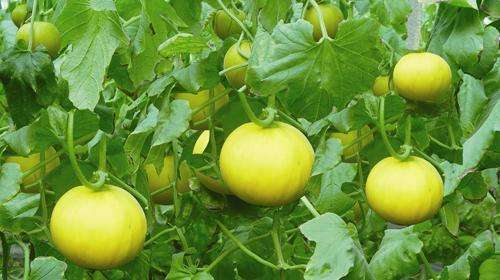
Key Technical Points for Vertical Cultivation of Muskmelon: Fertilizer Rates and Water Management
The management techniques for vertical cultivation of muskmelon are not difficult, but because the facilities used are relatively expensive, far higher than the cost of tunnel-style cultivation, ordinary farmers cannot afford them, which has become an obstacle to large-scale promotion, and for this reason its cultivation techniques and muskmelon field management and pest and disease control have not been passed on to ordinary farmers.
With the changes of the times and the improvement of living standards, increasing yield is no longer the most important consideration in the cultivation of each crop. How to improve quality to increase competitiveness is now the greatest requirement for each economically cultivated crop, and the muskmelons produced by the vertical cultivation model have a high degree of uniformity in fruit size and a symmetrical and beautiful skin color, making them truly the best gift to give.
Cultivation Key Points
1. Row and plant spacing: In terms of unit area, planting 2100-2400 plants per 1000 sq m is appropriate. Depending on the different cultivation settings, refer to the following row and plant spacings for transplanting.
1. Double-row planting method: bed spacing 1.8 m with two rows planted, row spacing 90 cm, plant spacing 40-45 cm, bed height about 30 cm.
2. Single-row planting method: bed spacing 1.2-1.3 m, plant spacing 35-40 cm, bed height about 30 cm.
2. Fertilizer rates: For soil cultivation, for general soil, applying 2000-4000 kg of organic fertilizer, 80-100 kg of Taifei No. 43, and 40 kg of superphosphate per 1000 sq m is appropriate. During the growing period, especially after the pollination period, carry out 2-3 foliar fertilizer applications to maintain leaf vigor. Many commercial brands are now available for selection; alternatively, supply water and nutrients by installing drip irrigation tubes.
3. Application of beneficial microorganisms: Inoculating beneficial microorganisms (arbuscular mycorrhizal fungi) during seedling raising or transplanting can improve the plant's absorption and utilization rate of phosphate fertilizer in the soil, save on the amount of phosphate fertilizer applied, and increase the plant's growth vigor. Many commercial products are also available for purchase nowadays, but care must be taken that the application of fungicides must be restricted during the period of beneficial microorganism inoculation, so as not to affect inoculation efficiency.
4. Vine retention, pruning, and vine training: The principle is single-vine pruning (retaining the main vine). Train the main vine to stand upright on the melon net (or use plastic string to guide it), and remove the side branches or secondary vines that emerge below the 10th node as early as possible to promote the growth of the main vine. When the main vine has grown to about 160-200 cm, or when the main vine has 25-28 nodes, pinch off the growing tip. Apart from retaining the secondary vines that emerge from the 11th-14th nodes, all other secondary vines are cut off entirely from where they arise (Earl's varieties); or, apart from retaining the topmost 1-2 secondary vines and pinching them after one leaf, all other secondary vines are also cut off from where they arise (non-Earl's varieties). On the day the female flower at the first node of the reserved fruiting branch (secondary vine) opens, or 1-2 days before, pinch this secondary vine after two leaves to promote female flower development. At the same time, prune 3-4 old leaves at the base as well to improve ventilation. The entire plant type should retain more than 20 mature leaves on the whole plant, and at least more than 14 mature leaves above the fruiting branch; if the selected variety is not of the Earl's system, then additionally retain 1-2 shoots of grandchild vines at the topmost end and allow them to develop to maintain plant vigor and prevent premature senescence.
5. Pollination and fruit set:
1. Commercially sold pollinating bees can be used to assist with pollination. Move the pollinating beehive into the facility at night three days before flowering at the fruit-bearing node, so that the bee colony can adapt to the environment. The colony required per 1000 sq m is 2000-3000 bees (about one box with 4 frames is sufficient), and the pollination period for the same batch of plants is about 5-7 days to complete pollination of each fruiting branch.
2. If the weather is continuously cloudy and rainy, the activity of the bee colony weakens, or if the unit area is small and bees are not needed to assist with pollination, then artificial pollination must be used. Completing pollination from just after dawn to before 9 a.m. can achieve the greatest effect.
3. Growth hormones should not be used: Although many fruit-setting promoters have been developed commercially, because the application of such agents tends to make fruit enlargement less uniform, the netting of muskmelon also finds it difficult to reach the grade of premium products, and the sugar content is also slightly reduced, so it is not recommended to use them when producing premium products.
6. Fruit retention, fruit hanging, and bagging: 5-7 days after successful pollination, the young fruit has developed to about the size of an egg (fruit length 4-7 cm). At this time, select those with good development, appearance, and fruit shape and hang them from the fruit stalk with a hook onto the melon net, or tie them from the fruit stalk with plastic string and hang them on the crossbar of the facility. After the selected fruits have been hung, cut off the remaining fruits. Note that when hanging fruit, it is best to make the secondary vine perpendicular to the main vine to facilitate the transport of nutrients and water. Thinning fruit is best done on a sunny morning, avoiding operation on cloudy and rainy days. Bagging can prevent skin hardening and fruit drying caused by excessively strong light, and also has the effect of preventing pesticide solution from adhering to the fruit skin, making the fruit skin color more attractive. In practice, using old newspaper can achieve the effects of shading, moisture retention, and breathability.
7. Water management: For soil cultivation, sufficient water must be given at transplanting to ensure that the young plants can successfully survive; near the flowering period, soil moisture should gradually be reduced to favor flowering and fruit set; during the young fruit development period, water demand increases, and water must be supplied sufficiently to favor full fruit development; when the first cracks are observed, care must be taken that water is not excessive, so as to avoid cracks that are too large and affect appearance; after the netting has formed and stabilized, water again to slightly raise the soil moisture content, so that the fruit can develop to the size it should have; afterward, control the soil to maintain a low moisture content, on the principle of not causing the plant to wilt.
8. Harvesting: Record the flowering period to calculate the number of days to maturity, or when yellowing due to magnesium deficiency is observed on the small leaves on the fruiting vine of healthy plants, first harvest 1-2 fruits to test their sugar accumulation in order to adjust the harvest period. At harvest, leave a T shape at the stem end to improve appearance.