Succulent leaf cuttings really aren't that simple; you need to master these practical tips
We all know that many succulents are actually propagated from leaf cuttings, and sharing succulent leaves is quite popular now. People exchange succulent leaves with each other to propagate succulents and chat about growing tips along the way. Many gardening enthusiasts are also searching everywhere for methods on how to take succulent leaf cuttings. This article compiles insights summarized by gardening enthusiasts who consider themselves to have years of succulent-growing experience. These experiences are well worth learning from and drawing on.
How to take succulent leaf cuttings
Leaf cuttings are a method of asexual propagation for succulents. Going from a leaf to slowly growing into a separate plant is a magical process. After a year of exploring and learning in a greenhouse, and paying countless tuition fees (losing many plants), here is a summary of leaf cuttings:
To do leaf cuttings, you first need healthy, plump leaves. Note that they must be healthy and plump. If the outermost layer has leaves that are being consumed or are drying up, the success rate generally won't be very high, so it's recommended not to try. Removing leaves from the plant is a delicate job that requires patience, but there's also a small detail to tell everyone here: about a week before you decide to remove the leaves, you should stop watering the plant so the leaves aren't too plump with water; otherwise, the leaves may get torn or broken off.
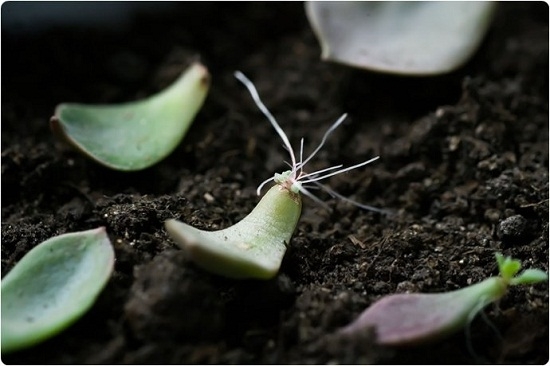
The ones in the picture below are the correct way to open them, forming a crescent shape. Roots and a new plant will grow a new individual from the middle of the crescent! We also call the middle of the crescent thegrowth point。
After the leaf is removed, it needs to be dried so the wound heals quickly. Generally, after three or four days, you can insert the leaf into the soil!
About the methods of leaf cuttings: There are all kinds of ways to insert leaves online: some lay them flat, some bury them in the soil, and some even insert them upside down. We've tried various methods too,and in the end, the more scientific method we concluded is to bury the growth point side shallowly in the soil.Burying it in the soil is so that after the leaf grows new roots, they can immediately go into the soil to absorb water and nutrients. At the same time, it also avoids the newly grown roots being directly exposed to the sun. Since new roots are very weak, they may dry out and lose vitality after being exposed to strong sunlight! Shallowly is to avoid inserting too deep and affecting the formation of the new individual, reducing the situation where only roots grow and no buds grow!