How to Graft Succulent Plants? A Detailed Explanation of Three Typical Propagation Methods
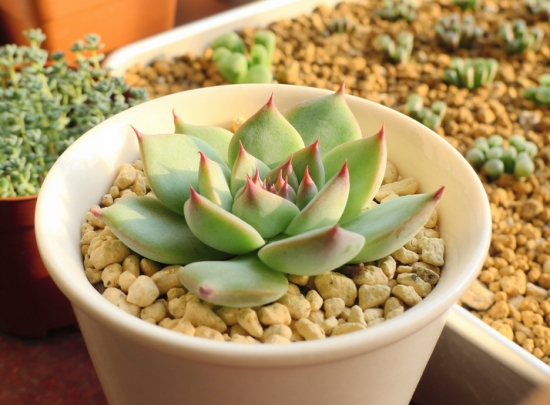
I. Grafting method for cacti:
1. Grafting of cacti is relatively simple to perform; use a thinner blade.
2. Grafting should be done during the growing season; the most suitable season is the peak growth period in early summer. Choose a sunny day with high temperature and humidity for grafting. When the air is dry, it is best to operate in the early morning.
3. When selecting rootstock and scion, choose healthy, disease-free ones. Do not use parts that are too old and lignified, but ones that are too tender are also unsuitable.
4. The height of the rootstock graft junction is determined by multiple factors. Varieties without chlorophyll should be grafted higher to ensure sufficient light and photosynthate supply.
5. About 2 weeks of careful management is needed. After grafting, place in a shaded area, away from direct sunlight, and do not let the graft junction get wet before it has completely healed. After successful establishment, side buds and side branches growing from the rootstock should be removed as early as possible to avoid affecting the growth of the scion.
II. Grafting method for ball cacti:
1. You need a healthy, viable grass ball cactus with a diameter of no less than 5cm.
2. You need ready grafting material of crab claw or finger cactus, with leaves that have grown for no less than one year.
3. Prepare a blade, a small knife, and scissors.
4. Choose a pot of grass ball cactus with a diameter of no less than 5cm, and use scissors to cut off all the small spines at the top.
5. Sterilize the blade with alcohol. Place the blade at the center of the ball between two ribs, and cut vertically downward to make an opening about 1.5cm wide and about 2cm deep (do not cut on the ribs, to avoid greater deformation later). For one with 12 ribs, cut half on each side; for one with 11 or 13 ribs, make one side have one more and the other side one fewer.
III. Grafting method for Echeveria:
1. The lower leaves of the old Echeveria stem fall off, forming a “bare leg”.
2. Use the old plant as the rootstock and red-leaf Echeveria as the scion .
3. Remove some of the leaves from the top of the old Echeveria, exposing about 5 cm of the stem .