How to propagate succulents? Four common propagation methods
Every friend who grows succulents thinks about propagating some adorable little succulents themselves. This not only fills out their small garden but also lets them fully experience the joy of growing plants. So how do you propagate succulents? Let's look at these four common succulent propagation methods.
I. Sowing
Among succulents, apart from a few species that can self-pollinate, most are insect-pollinated or bird-pollinated flowers and must be pollinated by hand in order to set fruit.
The seeds of succulents have a short lifespan; for example, the seeds of Haworthia cooperi var. pilifera last only a few weeks. Generally, succulent seeds stored at room temperature for 1 year quickly show a drop in germination rate. For this reason, many succulents are sown immediately after the seeds mature, or the seeds are stored and sown in the following spring.
II. Cuttings
Cuttings are the most commonly used propagation method for succulents. The common ones are leaf cuttings, stem cuttings and root cuttings.
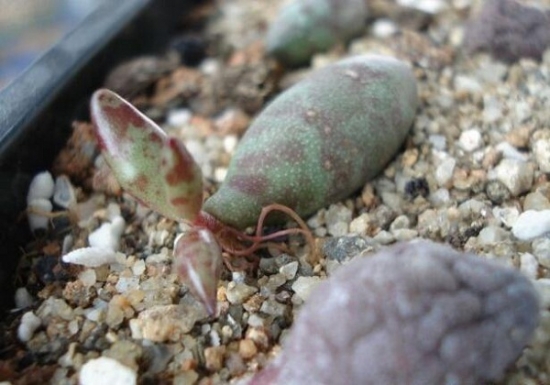
1. Leaf cuttings: thick, fleshy leaves are usually laid on a slightly moist sand bed or loose soil surface. They soon root, and adventitious buds grow from the base of the leaf to form small plants, such as Adromischus, Echeveria and Kalanchoe daigremontiana.
2. Stem cuttings: in the propagation of succulents, combined with pruning and shaping, branches are cut into sections as cuttings, such as Adenium obesum, Stapelia, Euphorbia milii and Euphorbia tirucalli. For Adenium obesum, African cactus and Euphorbia tirucalli, whose cut wounds exude white latex, the cut must be cleaned thoroughly and allowed to dry slightly before taking the cutting, for better results.
3. Root cuttings: the roots of valuable varieties such as Haworthia truncata are very thick and well developed. A relatively mature fleshy root is cut off and buried in a sand bed with the upper part slightly exposed. Keeping it somewhat moist and in bright light allows new buds to sprout from the top of the root, forming a complete small plant.
III. Grafting