Can the roots of Lucky Bamboo be cut off? Explanation of disease prevention measures
Lucky Bamboo (Dracaena sanderiana) has thick stems and large leaves, making it a very suitable evergreen plant for indoor foliage display. Precisely because its thick stems and large leaves consume a large amount of nutrients, its root system is also relatively well developed. After being grown for a long time, its roots will densely cover the bottom of the container, so can the roots of Lucky Bamboo be cut off?
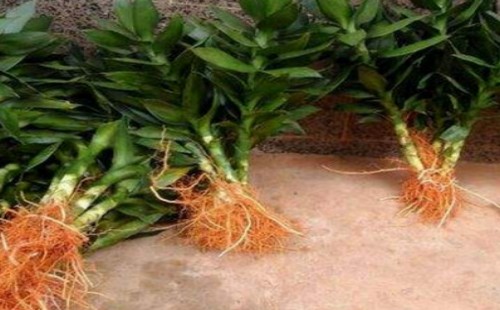
Because Lucky Bamboo has a powerful root system, when fertilizer is sufficient the roots themselves will also grow very densely, and if there is not enough space in the pot, these roots will become tangled and intertwined with each other, which at best inhibits root respiration and reduces absorption capacity, and at worst may cause root rot. Therefore, proper root pruning is beneficial whether for promoting the sprouting of new roots, improving the root's absorption capacity, or for the growth of the plant.
Moreover, Lucky Bamboo can use stem cuttings without roots for water culture to induce rooting, so it is usually possible to cut off its roots. However, if the roots are cut off when it is grown in soil, it is like re-propagating by cuttings, which often leads to difficulty in rooting, thereby easily causing the plant to turn yellow, drop leaves, and in severe cases may even die.
Therefore, whether the densely grown roots of Lucky Bamboo can be pruned often needs to be decided according to whether it is water-cultured or soil-cultured. If it is water-cultured, its roots can usually be cut off directly; but if it is soil-cultured, the roots often cannot be cut off directly. And even if root pruning is carried out on soil-cultured Lucky Bamboo, it generally still needs to be water-cultured first to grow roots, and only then can it be transferred to soil culture.
But if soil-cultured Lucky Bamboo develops root rot, on the one hand we can cut off all its roots, keeping only the stems and a small number of leaves on the upper part of the stems for water culture to grow roots, and then carry out soil culture; on the other hand, if the degree of root rot is not deep and the roots are growing very densely, we can prune the roots appropriately, mainly by cutting off the rotten root parts and the slower-growing, weaker old and thin roots, and then carry out soil culture.
In fact, whether Lucky Bamboo is water-cultured or soil-cultured, as long as root rot has not occurred, there is generally no need for root pruning, because the degree of development of its root system is also relative. Compared with foliage plants such as Lucky Bamboo (Dracaena sanderiana) of the fortune bamboo type, its root system can be considered rather underdeveloped. If Lucky Bamboo is blindly pruned or cut at the roots, it is very likely to cause poor growth of the plant.