Can a boxwood without leaves still sprout and survive? Detailed explanation of cultivation methods and disease prevention
Old boxwood stumps are one of the best materials for making stump bonsai, but sometimes the stump specimens we obtain have lost all their leaves for various reasons. So, in this case, can an old boxwood stump still survive and sprout? In fact, it is not only that. When we dig up wild-collected boxwood stumps and transplant them, we generally also adopt the practice of truncating the trunk and building up branches, shortening the branches and trunk while removing the branches and leaves, leaving the stump looking bare, and then cultivating the stump. But to make a boxwood stump sprout, you first need to keep it alive, and only then can you hope for buds.
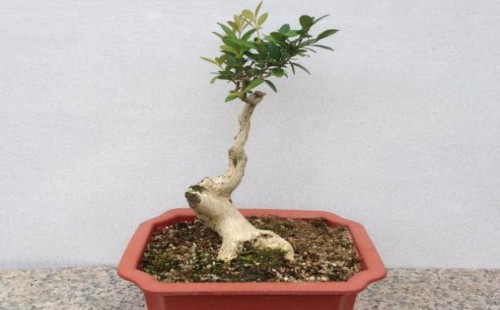
First, we need to buy wild-collected stumps at the market in early spring, since stumps dug up in this season are more likely to survive after transplanting. When choosing a stump, carefully examine its condition; to ensure it survives after transplanting, the old stump should have relatively fresh roots and branches. After buying the stump, prune it. Mainly, cut away the old, weak and thin roots to stimulate the plant to smoothly send out new roots after transplanting, and at the same time cut off the messy branches that are unfavorable for shaping, and properly shorten the main trunk and forks.
After the above treatment, some branches and leaves are generally still kept, which is better for survival. But if, due to mistaken pruning or necessity, the wild-collected boxwood stump has been pruned bare, with not even a single leaf retained, then for cultivating the boxwood stump this often requires a longer time, since leaves can absorb light to promote photosynthesis, accumulate nutrients, and promote growth. To make it sprout smoothly, we first need to ensure the stump can survive. This requires the stump to have intact roots and trunk, and the trunk must also have some bud points. After the stump has these basic growth conditions, through our careful care, it can still survive.
Of course, the process of cultivating the stump is very important. For a boxwood stump without leaves, during planting we need to cover it with deep soil, covering its roots as completely as possible with soil and mounding it higher than the uppermost base roots, and in this case it is recommended to plant it in the ground rather than cultivate it in a pot. During this period, pay attention to spraying water frequently to retain moisture, keeping the branches and trunk of the stump at a certain humidity, but the humidity of the pot soil should not be too high; instead, it should be kept slightly dry while retaining moisture, and the soil should be loose, which is more conducive to the boxwood stump taking root and sprouting.
After careful maintenance and management, generally by Qingming Festival, as the weather gradually warms and the temperature begins to rise, the bud points on the boxwood branches and trunk or the latent buds in the bark will poke out their “little heads”, thus sprouting new branches and leaves. This is also enough to prove that the leafless boxwood stump is gradually surviving. After another period of maintenance and management, once the young branches and leaves of the boxwood have a certain resistance, we can move it from the state of ground cultivation to a pot for transplanting.
It can be seen that boxwood is relatively easy to keep alive. Even in a leafless state, as long as its trunk and root system are intact and you choose the right time to cultivate the stump, through our meticulous care it can still be expected to survive and sprout smoothly.