Detailed Explanation of Camellia Bonsai Propagation Methods
Camellia is one of China's ten most famous flowers and a world-renowned ornamental flowering tree species. Its leaves are evergreen and never wither, emerald green and glossy, and its flowers are extremely gorgeous, with blooms so dense they resemble brocade - truly a tree of ten thousand buds, beautiful and delightful. Camellia is native to the southern provinces of China and Japan. It prefers a warm and humid climate and grows well in dappled shade. It fears the scorching sun of the north and is not cold-tolerant; the overwintering room temperature must not be lower than 6°C. The optimum growing temperature is 15-25°C, and growth generally stops above 29°C. Camellia has strict soil requirements and can only grow in acidic soil. If the soil is alkaline, the leaves will gradually yellow and drop, eventually leading to death.
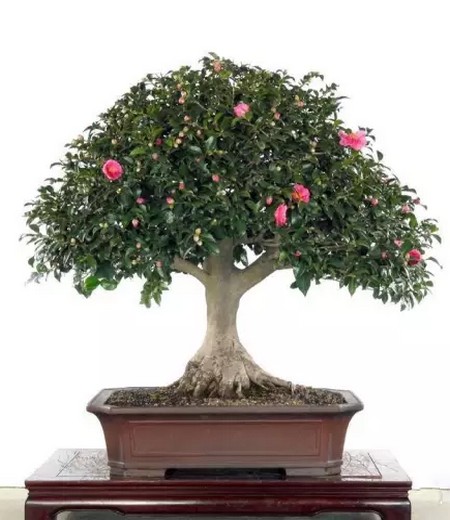
Camellia can be propagated by sowing, cuttings, layering and grafting. Varieties with strong double-petaled flowers mostly cannot set fruit after flowering, so seeds cannot be collected. Seeds from single-petaled varieties can be collected to grow rootstock seedlings for grafting double-petaled varieties. After the seeds mature, it is best to sow them immediately upon collection. If sowing in spring, the seeds should be stored in sand for a winter and sown in February to March of the following year; after sowing, it takes more than 2 months for seedlings to emerge.
Cutting propagation requires pre-treatment of the branches. In September, select fully grown current-year branches, remove the lower leaves, keeping only 3 leaves per branch, then choose an appropriate spot and peel off a ring of bark; a ring of tumor-like callus will gradually grow at the wounded area. In late January of the following year, cut the branch off from below the callus, wrap the cut end and callus with mountain clay or peat, then insert into moist plain river sand to let it take root and sprout. This method has a high survival rate and fast rooting.
When the propagation quantity is small, the high-branch layering method is mostly used. Perform high-branch layering in late September, cut away from the parent plant in April to May of the following year, plant 5-10 plants in a large flower pot, and place in a shaded area for care. After 1 year of growth, divide and pot the seedlings in March of the following year; with careful management, they can bloom before the Spring Festival.
Grafting includes branch grafting and bud grafting, usually using camellia oil tea or single-petaled camellia as rootstock. Branch grafting is done from May to July. For cut grafting, generally cut off the rootstock at about 5 cm above the ground, split the center of the rootstock to a depth of about 1.5 cm; the scion is 3-5 cm long with 1-2 leaves, its lower part cut into a wedge shape, inserted into the rootstock slit; after aligning the cambium layers, tie and bind, then cover the outside with a plastic bag to retain moisture, but do not tie the lower opening too tightly. For some precious varieties that are difficult to root, the approach grafting method is mostly used, usually carried out in May to June. About 3 months after approach grafting, once the union has healed firmly, the scion should be cut off from the base of the union to separate it from the parent plant; at the same time, the rootstock should also be cut off above the union, making it a new plant.
There are many propagation methods for camellia; both sexual and asexual propagation can be used, among which cuttings and approach grafting are the most commonly used.
Tools: blade, grafting clip
Method steps:
1. Cutting method