What are the feng shui considerations for pine bonsai?
Feng shui is not superstition; it is one of China's traditional cultures, and it contains a great deal of knowledge within it. Modern China has undergone earth-shaking changes, and much traditional culture has also been damaged, so people today can no longer see the full picture of feng shui studies. True feng shui studies should be the scholarship of architecture, geological structure, architectural art, gardens, urban planning, and all the knowledge that can be used in building a home.
Pine trees and cranes are the most common of things, but in the minds of the ancients, each had its own divine and extraordinary endowment. The pine is called the "chief of a hundred trees," evergreen and undecaying; it is said that when a pine tree lives over a thousand years, the resin it exudes turns into fuling (poria), and those who consume it can attain immortality. Therefore, when the ancients pursued the Dao, they loved to choose ancient pines as places for cultivation, precisely in order to eat fuling as an aid. The crane is called the "head of a hundred feathers," and its origins are said to be twofold:
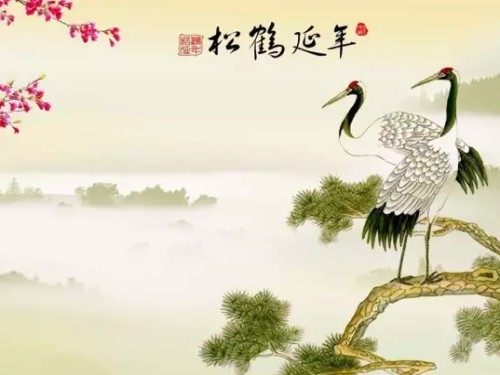
One part is transformed from essential qi: at seven years it undergoes a small change, at sixteen years a great change, at one hundred and sixty years the changes stop, and at one thousand six hundred years its form is fixed, and it can serve as a mount for immortals.
The other part is what ordinary people transform into after ascending to immortality. Consuming pine resin allows one to ascend to immortality, and after ascending one can transform into a crane, hence the saying "a thousand-year crane relies on a thousand-year pine," which links the pine and the crane together. As recorded in the Record of Divine Realms, the auspicious painting Pine and Crane of Long Spring is based on this; besides being used to wish longevity to both members of an elderly couple, it is also broadly used as a symbol of ascending to immortality.
Through the ages, who knows how many aspiring scholars and literati have sung in praise of the pine and written poems in its honor. They praise the pine's solemn dignity and proud, towering spirit; they celebrate how the pine endures cold without decline and stays evergreen through all four seasons. The pine is the chief of a hundred trees; it tolerates barren soil, and can grow in shady cracks in barren rock (as the famous pines of Huangshan prove). It defies frost and snow, staying evergreen through all four seasons without withering, symbolizing constancy and eternity. The pine is the longest-lived tree species in the world, enjoying a lifespan of ten thousand years; as the saying goes: a thousand-year turtle, a ten-thousand-year pine. In Chinese folk custom, birthday congratulations often include the phrase "May your fortune be like the ever-flowing waters of the East Sea, and your longevity like the undying pine of the Southern Mountain." There is a poem by Zhong Jiao of the Song dynasty, "Ancient Pine at Jinglin Temple," as evidence: "Ancient pine, ancient pine, growing by the ancient road; its branches bear no leaves, its bark bears grass; travelers do not see when the tree was planted, but the tree has seen travelers grow old how many times."
Pine bonsai is one of the most popular bonsai among modern bonsai enthusiasts; it can be placed indoors, on balconies, in courtyards, and in public places. It serves a very good decorative function, and at the same time the pine trees grown in pots are generally not tall, about 30-80 cm in height, but the branches of pine bonsai are relatively varied and can display their beauty in different forms. At the same time, the pine has the title "evergreen pine of the green mountains," and in feng shui the pine represents longevity and the vigorous vitality of life, so it is deeply loved by people.