What feng shui considerations are there for placing bonsai in the office?
People pay great attention to the feng shui of their own homes, believing that if the bonsai in the home are placed according to feng shui principles, it will keep the household safe and bring wealth to the family. Company bosses, meanwhile, pay close attention to the feng shui placement of office bonsai: if the company's feng shui is good, employees will work actively, business will keep growing, and their own wallets will get fatter and fatter.
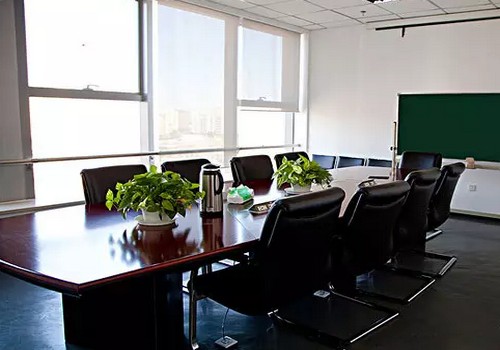
Companies are generally in a relatively enclosed environment, fairly airtight, with no one around at night and left in darkness, and since there are many people in a company, the carbon dioxide produced by breathing also affects the photosynthesis of bonsai. The office temperature is not as constant as at home: during the day when the employees are there, the temperature is relatively high, while at night when no one is around, it drops, so you should choose bonsai that tolerate a fairly wide temperature range, to better adapt to the office environment. So what are the feng shui principles for office bonsai? Which bonsai should you buy and how should they be placed?
1. Placement: Never place petite, hard-to-care-for plants on the office desk.
Such plants easily tire out their owner; the whole point of placing plants is to draw on their vitality to boost the owner's energy and spirit, but when you run into delicate, troublesome things, they instead sap away a person's vital energy. No matter which kind of plant is placed in the office, you must take good care of it; those with withered leaves, or half-dead, must be trimmed and tended promptly, and if all else fails, thrown away. If the flowers and plants go moldy, the owner is also prone to bad luck.
Flowers with unusual or strong scents, such as night-blooming jasmine (cestrum nocturnum) and lilies, are also not recommended for the office, as they easily cause dizziness and make people restless. Spiky, angular plants like cactus balls must never be placed right in front of you; covered in spines, how are you supposed to communicate with people? Just imagine: your supervisor is about to explain something important to you, and suddenly gets pricked by the cactus ball on the desk until the skin breaks and blood comes out; everyone is embarrassed. So they should be placed in a corner to guard against sha. Put them in turn-of-the-corner spots that are hard to see and that people rarely go into; that way they do not hurt anyone, and can instead block sha.
2. Direction: At the entrance foyer of the main door, beside the toilet, and at passage openings, try to place green evergreen broadleaf plants.
These can block sha and gather wealth; of course, the most obvious function is blocking cross-ventilation drafts. Spider plants (chlorophytum) can be placed at wall corners to soften sharp angles. If you face a wall or glass directly, you can place vine-type or broadleaf plants, but do not put fake flowers or fake grass. Seeing lush greenery everywhere relaxes the mind, and especially during busy work it gives your eyes a chance to rest. If your back is against a wall, then you can put up decorative paintings with patterns such as pine and cypress or peonies. If your back is against glass, especially transparent glass, then you should place plants with angular stems and spines, such as gladiolus, which can guard against petty people and avert quarrels. If the office space is cramped and there is no room for plants, consider sticking red or green plant patterns on the glass; seeing red brings joy, seeing green brings vitality.
3. Color: Distributing plants by color across the different Five Elements directions can activate and strengthen the energy field of those directions.
By the color of the plant's flowers: green (east) belongs to wood, white (west) belongs to metal, red (south) belongs to fire, blue (north) belongs to water, and yellow (center) belongs to earth. The owner's clothing color should match that of the flowers; this is called mutual generation. Matching has two levels: first, choose the color according to the overall direction. If your position faces east with your back to the west, and the east belongs to wood, then place green plants in front of the desk, such as monstera (guibei zhu) and the like. If you face south with your back to the north, and the south belongs to fire, then place plants with red flowers, such as peach blossom and goose-foot plant (schefflera). The rest follow the same pattern. Second, match your own clothing to the flower color; for example, if you place blue-toned flowers, then wear formal business attire mainly in blue, black, and gray. Through the pairing of flower and clothing colors, the relationship between the Five Elements and the person is expressed, thereby supplementing the energy field.
The space for placing plants in an office is subject to some limitations; the indoor temperature is suitably around 24 degrees, but a small day-night temperature difference easily lowers the plants' resistance. Air quality is relatively poor, air circulation is also relatively poor, light varies greatly between different positions, and there is a lot of foot traffic.
Placement suggestions:
For plant arrangements in an office, besides their decorative role, air purification is also very important. Because office equipment such as computers and monitors has increased, radiation has increased too, so it is especially important to use plants with a strong air-purifying effect and high ornamental value, such as pothos (lvluo), green king (lv bawang), and similar plants. In addition, due to space constraints, using hanging plants such as spider plants can also add a sense of layering to the greenery.
Recommended plants:
Spider plant (chlorophytum), hanging green pothos, Brazilian wood (dracaena fragrans), Dutch iron (yucca), broadleaf lady palm (rhapis), areca palm (sanwei kui), fish-tail palm (yuweikui), king coconut, pothos, Malabar chestnut (pachira), black diamond (heijingang). Plant growth is very closely related to the surrounding environmental conditions and requires suitable environmental conditions. The conditions plants need during growth - temperature, light, air, water, and soil - cannot all be met in an office environment. But reasonable placement and plant selection can satisfy the plants' temperature, light, and air needs; the remaining water, soil, and fertilizer need to be handled by professional horticultural company staff.
Environmental characteristics:
The space for placing plants is relatively large, the temperature is suitable, generally around 25 degrees, the day-night temperature difference does not change much, ventilation is not very good, sunlight is relatively poor, but lighting is fairly good.
Placement suggestions:
For different placement positions, pay attention to the plants' light requirements. Light-loving and relatively tall plants should be placed at the lobby entrance as much as possible, such as sago palm (tie shu) and five-needle pine; more shade-tolerant plants can be placed in corner positions such as the elevator entrance, such as broadleaf lady palm (rhapis), pothos, umbrella tree (yazhang mu), and lucky bamboo cage (fugui zhu long).
Suggested plants:
Large bonsai (five-needle pine, luohan pine, sago palm, etc.), areca palm (sanwei kui), fish-tail palm (yuweikui), king coconut, Malabar chestnut (pachira), broadleaf lady palm (rhapis), umbrella tree (yazhang mu), lucky bamboo cage (fugui zhu long), purple-backed arrowhead (zi bei zhu yu), and so on.