Detailed Explanation of the Key Technical Points for Formal Upright Bonsai Styling
The styling characteristic of the formal upright style is a trunk that is upright or basically upright, belonging to the tall and vigorous tree type, and is also the basic tree form of arbor species.
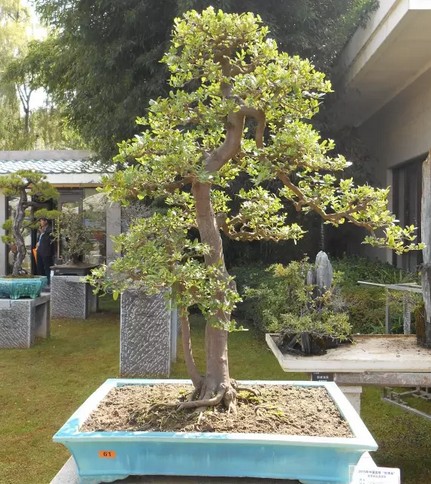
(1) Selecting the planting material
An excellent planting material should have the following characteristics:
(1) A perfect root spread.
(2) A rugged, upright trunk base.
(3) A trunk of moderate thickness, becoming progressively thinner toward the top.
(4) Branches covering the sides of the trunk.
If, during the young tree stage, the trunk is found to be slightly curved, it can be restored to straightness by binding with wire. If used as a main branch, it should be thicker and longer the lower it is positioned. In addition, the distance between two branches should, as a rule, become narrower the higher up they are positioned.
(2) Key points of shaping
Generally speaking, the formal upright tree type is quite difficult to shape and cultivate, requiring shaping through composition, crown formation, and the development of side branches in an all-around manner, striving to achieve a sense of movement and spirit within monotony and rigidity, so that the work achieves a breakthrough and takes on new meaning.
Distribution of the main branches: Broadly speaking, the main branches of the formal upright tree type should be distributed according to certain rules. First, the first branch should face right (or left) and angle slightly forward, while the second branch extends left (or right) (alternating branches), in order to achieve stability. The third branch is placed at the rear, thereby showing depth, and is also called the back branch.
From the fourth branch onward, the positional distribution is as described above: the lower branches are nearly horizontal or droop slightly, and the higher up they are positioned, the greater the angle of inclination, which carries great weight in the presentation of young branches and gives a sense of beauty. The degree of drooping of the main branches differs depending on the species.
1. The crown is winding and turns in many directions, but ultimately does not deviate from the central axis of the main trunk; it is a centered crown, perfectly upright. (See Figure 1 below) Figure 1: Using a double cascading branch design to strengthen the sense of movement on the left. Whether the newly cultivated crown branch curves left or right, it ultimately returns to the central axis, with a tall, vigorous and upward-reaching momentum, a typical literati style personifying the upright gentleman.
2. The crown is winding and turns in many directions, ultimately deviating from the central axis of the main trunk, presenting firmness below and softness above, a combination of firmness and softness, dignified and generous. (See Figure 2 below) Figure 2: The trunk form is straight below and curved above, with the crown extending to the left, forming a strong contrast with the upright trunk, the firm being especially firm and the soft being especially soft. The newly cultivated right-extending cascading branch takes its momentum toward the right, belonging to the standard welcoming-guest style.
3. A short, formal upright large-tree style with a centered crown. The first branch starts relatively low, mostly adopting an isosceles triangle composition, pursuing an artistic conception of stability as immovable as an iron tower. (See Figure 3 below) Figure 3: Low first branch, majestic and dense, adopting an isosceles triangle composition. Many black pines (Pinus thunbergii) in Taiwan, China and Japan have this style.
4. A graceful, lush formal upright style with a centered crown, between the literati-style formal upright type and the short formal upright large-tree type. The first branch starts at a moderate height, and the tree's appearance is not as robust as the short formal upright style, taking the strengths of both styles and forming its own elegant and lush character. (See Figure 4 below) Figure 4: The crown is perfectly upright, honest, kind, moderate, natural and poised, with a handsome bearing. It adopts an equilateral triangle composition and is favored by most people.
5. The natural, wild red cotton tree type. The red cotton tree, also called the hero tree, is a tree species unique to Guangdong, with a tall, upright trunk, awe-inspiring and full of heroic spirit. (See Figure 5 below) Figure 5: A common red cotton tree form in nature. The red cotton tree is characterized by a straight trunk and opposite branches. Its form can occasionally be adopted for bonsai creation.
6. A towering double formal upright style. This style is the most common: the main trunk releases a cascading branch at a high position to take momentum, while space is left at the top of the secondary trunk, making the secondary trunk clearly independent. The right cascading branch of the secondary trunk becomes a trunk-hugging branch of the main trunk. (See Figure 6 below) The formal upright style is the most basic styling form, and on the basis of understanding and applying it flexibly, many variations of the style can be created.