How to shape a Polygonum multiflorum bonsai? A few practical tips for you
Although Polygonum multiflorum has a huge tuberous root, its vines are slender and weak, and it hardly forms an obvious main trunk, so when shaping it, you can consider using the tuberous root to replace the trunk.
You can also take advantage of the plump tuberous root that resembles a rugged stone and treat it as an “ornamental stone” for shaping; it can be planted as a single specimen or combined in groups of several.
The vines can be kept or removed according to the needs of the design. After the leaves emerge, pay attention to pruning so that the layers are distinct, avoiding vines that grow too long and climb everywhere, making it look messy.
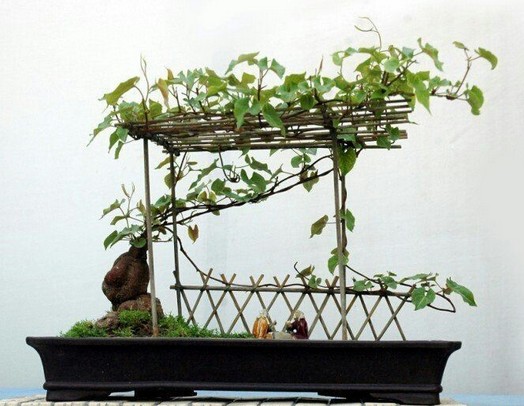
In addition, you can also set up a miniature “trellis” or “fence” in the flowerpot, arrange the vines and let them climb on it, forming a rustic and far-reaching farmhouse courtyard scene, giving the bonsai a pastoral poetic mood.
“Talking Over Wine About Mulberry and Hemp” is one such work, and its production process is as follows:
Plant a Polygonum multiflorum tuberous root with a natural, antique form resembling a curious stone in one corner of a rectangular flowerpot, make a trellis and fence with chopsticks, guide the Polygonum multiflorum vines onto the trellis, then toward the fence, and through pruning, shaping, water control and other measures, its vines are compact and the leaves are small and thick, making the bonsai properly proportioned. Then plant some small grasses in a scattered, well-arranged way on the surface of the flowerpot to create a natural landform, and finally place two old men dressed in ancient Han clothing and posed as if drinking in suitable positions, making the bonsai more vivid and full of pastoral charm.