A Detailed Guide to Shaping Methods and Techniques for Chinese Holly Bonsai
Chinese holly, also known as cat's thorn and Chinese holly wintergreen, is an evergreen small tree or shrub of the genus Ilex in the family Aquifoliaceae. The bark is grayish-white and smooth, and the small branches are densely grown and spreading. The leaves are simple and alternate, elliptical-oblong, leathery, with 5 hard spiny teeth, glossy on the surface, and dark green. The flowers are yellow-green and grow in the leaf axils. The drupe is spherical and bright red.
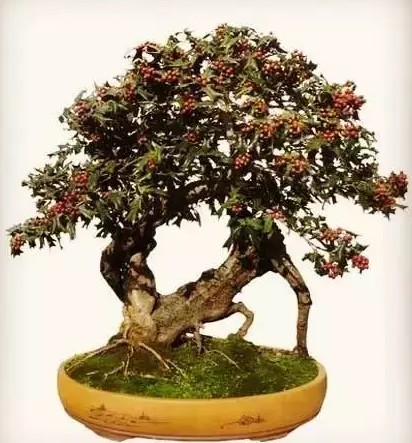
Chinese holly is native to the middle and lower reaches of the Yangtze River in China and is a subtropical tree species, often growing under forest in mountainous areas; it is shade-tolerant, prefers a warm and humid climate, and is suitable for slightly acidic, fertile, and moist soil; it has strong sprouting ability and is extremely tolerant of pruning.
After Chinese holly has survived, bonsai in different forms such as the lying-trunk style, slanting-trunk style, and curved-trunk style can be made according to the shape of the stump. The shape of the crown should be determined according to the variety. For large-leaf Chinese holly, an elegant natural style can be used, taking care that the leaves, branches, and crown are properly spaced and well arranged, and slight wiring and pulling can be applied, but it does not need to be pruned into a regular round disc shape; for small-leaf Chinese holly, it can either be pruned into a round disc shape or processed into a sparse and elegant natural form.
The wiring and shaping of Chinese holly is best carried out in early summer. A well-made bonsai can be moved into a fine pot for viewing in the spring of the following year, and the potting soil should be a well-drained, loose, fertile, slightly acidic soil.
The branches and trunk of Chinese holly are hard and brittle, so processing is usually carried out during the plum rain season, when sap flow is vigorous. Because its leaves are large and hard, it is generally better to use palm fiber for wiring, and metal wire should not be used, otherwise it is easy to cause broken branches and leaves. Chinese holly leaves are hard and have sharp spines. When shaping, unnecessary branches and leaves can first be cut off, and the remaining branches and trunk can be wired and pruned.
The tree form of Chinese holly can be made into the straight-trunk style, slanting-trunk style, curved-trunk style, and cliff-hanging style, etc. For small bonsai, the natural style is best, while for large bonsai, the branches and leaves can be tied into cloud-like layers, and old stump specimens can appear with the beautiful posture of the exposed-root style and bent-trunk style.