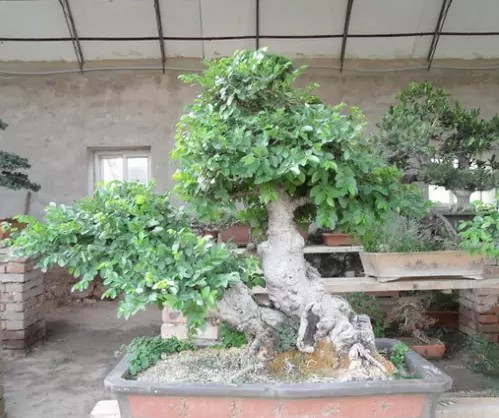
How to cultivate Chinese holly (Ilex cornuta) bonsai? A detailed guide to the method
The wood of the Chinese holly is soft and flexible, and can be used as a substitute for boxwood (Buxus) wood to make various utensils and carved items. Farmers use it as a nose ring for plowing oxen. It should have been a common and commonly used plant in the Yellow River basin during the era of the Classic of Poetry (Shijing). The bark and leaves can be used medicinally, having the effect of nourishing yin and clearing heat. The seed is known pharmaceutically as “Shidagonglaozi” (Mahonia seed), and is used in traditional Chinese medicine to tonify the liver and kidneys. The leaves are leathery and smooth, tolerant of pruning, and the fruit color is showy. It is often cultivated for ornamental purposes, and is therefore frequently used as the green leaves and red berries decorating Christmas trees in the West.
Artificial propagation:
Seed sowing is the main method of propagation, but cuttings and division (suckers) can also be used. The fruit ripens in November. After harvesting, pile the fruit up, and once the skin softens, mash it, rinse it clean, and take out the seeds. Chinese holly seeds require 2 years to germinate; they can be treated with cold moist sand for one year. During sand storage, stir and turn them once every two months to maintain a certain humidity and prevent the seeds from deteriorating. Sow the seeds in the winter of the following year, in rows 15-20 cm apart, at a sowing depth of 2-3 cm, cover with 1.5 cm of burnt soil, then cover with rice straw. They will sprout and emerge in March; uncover the straw in time and set up a shade frame. Pay attention to routine management such as watering, topdressing, weeding and loosening the soil. The seedlings grow slowly; leave them in the bed for 1-2 years before transplanting separately.
Cuttage propagation:
In mid-to-late June (the plum rain season), select semi-ripened shoots of the current year as cuttings, with a length sufficient to include a heel (a portion of last year's older branch). Keep 4-6 leaves, insert to a depth of 1B2-2B3, water thoroughly after inserting, set up a shade frame, water frequently and keep the soil moist. After rooting, strengthen seedling-stage management, leave in the bed for 1-2 years before transplanting; spring transplanting gives a higher survival rate. Root suckers can also be dug up for propagation.
Notes on potting Chinese holly:
Habits: The Chinese holly is an evergreen small tree or shrub of the genus Ilex in the family Aquifoliaceae. It likes a warm, humid environment with plenty of sunlight, but is also shade-tolerant and has a certain degree of cold hardiness. For potting, use a slightly acidic soil rich in humus, fertile and well-drained. Generally, pot it in spring before bud break in February-March; after planting, water thoroughly and place it in semi-shade to acclimatize for 2-3 weeks. In summer, when temperatures are high, increase ventilation, shade it slightly, and prevent exposure to scorching sun.
Environment: The Chinese holly is shade-tolerant and should be placed in a shady, humid environment to grow. In summer it needs to be kept under a shade frame or under tree shade. In winter it needs to be brought indoors to overwinter.
Watering: During the vigorous growth period, water frequently; generally keep the potting soil moist but not waterlogged. In summer, spray the leaves often to aid evaporation and cooling; a small humid air environment needs to be created so the leaves stay emerald green and glossy.
Fertilizing: Generally, in spring apply dilute cake fertilizer water once every 2 weeks; in autumn apply a topdressing once a month; in summer no fertilizer is needed; in winter apply fertilizer once. Generally, apply dilute alum fertilizer water once every 2-3 weeks. Note that the nutrients in the fertilizer solution must be comprehensive, so that the leaves are lush and the fruit abundant.