Detailed Explanation of the Styling Techniques and Methods for Podocarpus Bonsai
Podocarpus (yew plum pine) stays green all year round, has short branches and dense leaves, and grows slowly. Resources of small-leaved tree species are relatively scarce. Using cuttings to propagate and create small bonsai not only provides creative material but also helps protect the ecological environment. In a sand bed for seedling cultivation in a greenhouse, Podocarpus can be propagated by softwood cuttings. For spring cuttings (February to April) or summer cuttings (May to June), the cuttings should be taken from the soft, not yet mature and hardened portion of vigorous shoot tips, cut into cuttings about 8 cm long.
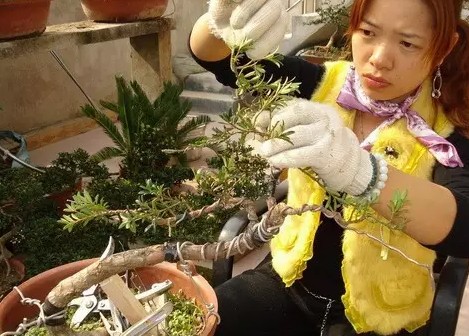
The commonly used techniques for Podocarpus include pruning, wiring, bending, bundling, and hanging. Pruning for styling is relatively simple, while styling techniques such as wiring, bending, bundling, and hanging are more difficult, requiring a high level of artistic imagination, operational skill, and suitable conditions of the tree's trunk and branches. During the styling process, artistic processing must be carried out according to the tree's own natural beauty, that is, measures must suit the tree, adding beauty to beauty, so that the styling is strong and powerful with clear layers.
1. Pruning: Taking advantage of Podocarpus's tolerance for pruning and its small leaves, various shapes can be created, such as spherical, conical, and multi-layered spherical forms, simply by pruning according to a pre-designed pattern. For example, when pruning a three-layer spherical shape, first select a seedling with an obvious trunk and good upright form. If the pruning design is a three-layer spherical shape with a total height of 2 m, then the lower layer is about 50 cm high, the middle layer is about 40 cm high, and the top layer is 30 cm high. All branches on the trunk must be cut away in the 45 cm between the first and second layers and the 35 cm between the second and third layers, and then the three spheres are pruned. It is best for the three spheres, upper, middle, and lower, to gradually increase in size so as to achieve coordinated proportions and better ornamental value. Generally, pruning is suitable when new shoots have grown 20-30 cm, and repeated pruning is needed to make each layer's sphere round, full, and compact.
2. Wiring: For wiring-style shaping, sturdy bamboo sticks and strong, tough hemp rope can be used. Tie the bamboo sticks and branches tightly and securely with hemp rope, then fix one end of the bamboo stick to the trunk, so that by adjusting the direction of the bamboo stick, the branches grow in a specific direction according to the stylist's intention, achieving the purpose of styling. It should be noted that wiring-style shaping is suitable for younger Podocarpus trees, while older Podocarpus trees, because their branches and trunks are thick and strong, make shaping difficult and the effect poor.
3. Bending: Bending-style shaping mainly uses methods such as bending and tilting the trunk to make the tree present, on a slanted plane, an artistic beauty completely different from that of an upright plane. Because the branches and trunk of Podocarpus resemble a person's arms, and the leaves clustered in hemispherical form at the tops of the branches and trunk resemble a person's palms, together with the bent tree body, it is just like a greeter bending at the waist and arms to welcome guests, very vivid and lifelike. It should be noted that after bending the tree body, wooden stakes must be used to support the tilted end to prevent the tree from falling over due to excessive tilting, and rice straw of moderate thickness should be placed between the contact surface of the wooden stakes and the tree body to avoid injury to the tree.