Cultivation of small trees for landscape bonsai originates from insights into how nature shapes trees
Bonsai starts from small seedlings, pruned once a year in the early stage, beginning with basic training; as time accumulates, the small tree naturally shows healed pruning cuts, and according to one's own needs and purposes, the tree's form is gradually perfected through continuous pruning. Young trees in the early stage have no degree of aging. Due to the characteristics of some tree species, such as Chinese privet (Ligustrum sinense), its bark's physiological characteristic is smooth and grayish-white, and after several years of cultivation it still shows no change, always looking somewhat tender - this is the trait of the variety. How can it be transformed? One has no choice but to observe the natural formation process of ancient trees in nature and analyze the conditions under which gnarled old trees are formed.
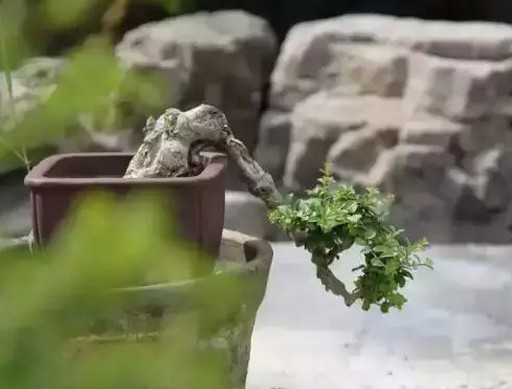
(1) Trees in nature rely on the heavens for survival; in years with abundant rain they grow vigorously, while in drought they die or lose branches, making the trees "die and come back to life." This is most commonly seen in trees growing on cliffs and precipices. Especially as reflected in a single tree, there is a dead part and also a living part, death and life embracing together, displaying the tenacity of life in nature and a kind of natural charm.
(2) Humans survive in nature; as the saying goes: those who live by the mountain make their living from the mountain. In the process of woodcutters going up the mountain to split firewood, various tree injuries occur, for example: splitting with an axe, forcefully twisting or splitting branches, or stripping bark, etc., as well as death and injury of branches caused by natural disasters and pests and diseases; through wound healing, years of damage from wind, rain, thunder and lightning, etc., the surviving ancient trees have endured great vicissitudes - this is the wonder of nature's uncanny workmanship.
From the above analysis, whether it is the "natural shaping method," the "artificial firewood-splitting method," or Guangdong's "hammering method," etc., one always seeks by every means to perfect the tree's form, posture, and degree of aging. After a very long period of "shaping," a "little old man" tree is cultivated for people to admire and appreciate. Only by constantly learning from nature, drawing on and reproducing nature's "natural shaping method" for trees, and then transforming it into techniques for bonsai creation, can bonsai-making skills be carried forward and further developed.