Pruning Methods and Techniques for Elm Bonsai
Deciduous tree, up to 25 m tall, 1 m in diameter at breast height, becoming shrub-like on dry, barren ground; bark of young trees smooth, grayish brown or light gray, bark of mature trees dark gray, irregularly deeply fissured, rough; branchlets glabrous or pubescent, pale yellowish gray, pale brownish gray or gray, rarely pale brownish yellow or yellow, with scattered lenticels, without enlarged cork layers or raised corky wings; winter buds subspherical or ovoid, bud scales glabrous on the back, margins of inner bud scales with long white pubescence.
Leaves elliptic-ovate, oblong-ovate, elliptic-lanceolate or ovate-lanceolate, 2-8 cm long, 1.2-3.5 cm wide, apex acuminate or long acuminate, base oblique or nearly symmetrical, one side cuneate to rounded, the other side rounded to semi-cordate, leaf surface smooth and glabrous, leaf underside with short pubescence when young, later becoming glabrous or with tufts of hair in some vein axils, margin doubly serrate or singly serrate, lateral veins 9-16 per side, petiole 4-10 mm long, usually with short pubescence only on the upper side. Flowers opening before the leaves, clustered in the leaf axils of growing branches.
Samara nearly circular, rarely obovate-circular, 1.2-2 cm long, glabrous except for the pubescence on the stigmatic surface at the apical notch, seed body located in the middle of the samara, upper end not reaching or reaching the notch, its color before and after maturity the same as the samara wing, initially pale green, later white-yellow, persistent perianth glabrous, 4-lobed, lobe margins hairy, pedicel shorter than the perianth, 1-2 mm long, with (or rarely without) short pubescence. Flowering and fruiting period March-June (later in Northeast China).
Pruning:
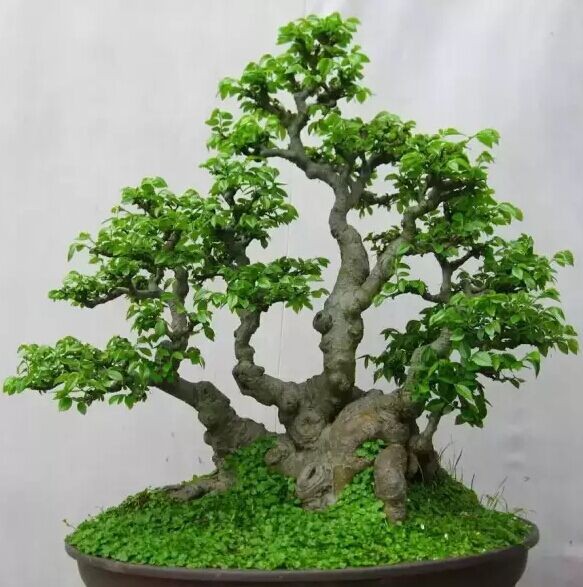
Pruning is done to shape a beautiful tree form, that is, to keep those branches in suitable positions for styling. Generally, dead branches, diseased branches and weak branches should be removed first, then water sprouts, crossing branches, parallel branches, reverse branches, central apical branches, radiating branches, opposite branches, vertical branches and the like that interfere with the tree's styling should be removed.
The cut should be smooth to promote healing. When pruning, generally no stubs should be left. For basically formed trees, only controlling pruning of protruding twigs and foliage is done to maintain a beautiful shape.
During the growing season, young shoots should not be pruned too frequently. Winter is the best time for pruning, when the leaves have all fallen and the branch structure inside the crown is clear; through pruning, defects can be eliminated, the styling perfected, and it helps concentrate nutrients in the following spring so that the retained branches grow better. With years of pruning, the bonsai's form will gradually become perfect.
Elm, especially old elm stumps growing in the wild, has experienced years of human chopping and hacking, or wind stripping and rain erosion, animal gnawing and so on, gradually forming many different and bizarre postures. Some have gnarled roots and are vigorous and ancient-looking; some turn decay into wonder, with dead roots and new leaves, opening up a world of their own, making them excellent material for making bonsai.