Detailed Explanation of the Key Points of Pomegranate Bonsai Shaping Techniques
Currently, pomegranate bonsai are in high demand in the flower market. Judging from market trends, pomegranate bonsai with attractive shapes sell quickly despite their high prices. Of course, good quality certainly comes from good cultivation techniques. Today, the editor of World Factory Modern Agriculture Network brings you a complete guide to pomegranate bonsai cultivation techniques.
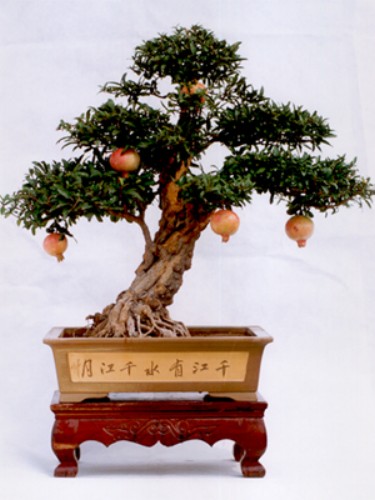
For thousands of years, under human cultivation and domestication, wild pomegranates have formed two major categories: one is the ornamental flowering pomegranate, and the other is the edible fruiting pomegranate. Ornamental flowering pomegranates are further divided into flower-viewing and fruit-viewing types, but they are mainly famous for their brilliantly colorful flowers. Especially when the spring light gradually fades and the flowering season is drawing to a close, the flaming red pomegranate flowers leap onto the branches, truly possessing the poetic charm of “one spot of red among ten thousand green leaves, moving spring scenery needs not be much.”
Pomegranate bonsai are sturdy and ancient-looking; in early summer they bloom with brilliant red flowers, and in autumn and winter their branches are full of splendid fruit, offering a unique charm. Pomegranates have extremely strong sprouting ability and can produce new branches several times within a year, allowing rapid creation of pomegranate bonsai.
Pruning and shaping:
Before spring buds sprout, cut off upright branches, water sprouts, overly dense branches and diseased or weak branches, correct the crown, and cultivate a thick trunk; for shaping, the straight-trunk style, slanting-trunk style and curved-trunk style are mostly used, with main pruning in early spring as the primary method and wiring during the dormant period as a supplement.
Shortening and pinching:
For branches that are disordered and affect the tree's form, pruning and cutting back should be carried out, but branches of varying lengths should still be maintained so that after cutting the branches form a non-uniform arrangement; be careful not to damage the fruiting mother branches cultivated from the previous year, and keep them balanced to display the collective beauty of the crown, which can maintain the tree's attractive vigor and save nutrients, benefiting abundant flowers and fruit the following year.
Thinning flowers and fruit:
To keep nutrients from being dispersed, when there are too many flower buds, especially at the end of flowering, a large amount of flower and fruit thinning should be carried out, which allows a certain number of fruits to grow and mature while also preventing physiological fruit drop; choose appropriate positions and keep 3 to 5 pomegranate fruits.
Corresponding measures:
Repot once every 1 to 2 years, in April to May or October. During the leaf-unfolding stage, bud stage and fruit growth stage, apply decomposed liquid fertilizer once every half month; after buds appear, apply 0.2% potassium dihydrogen phosphate twice, but note that no fertilizer should be applied during the flowering period. Daily sunlight must be guaranteed at more than 4 hours for flowering; it is not afraid of sun exposure; in winter, move it into a low-temperature indoor space and keep it at around 2 degrees C, which is beneficial for winter dormancy and next year's growth.