Detailed Explanation of Wiring and Shaping Methods for Camellia Bonsai
Camellia belongs to the Theaceae family and is an evergreen shrub or small tree. Camellia has a pleasant fragrance and abundant blooms, making it highly popular. It is often cultivated as a bonsai plant for indoor decoration, but before a camellia can be placed indoors, it needs to be wired and shaped. How do you wire and shape a camellia bonsai?
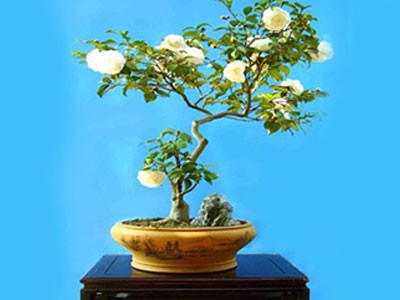
1. Selecting the right seedlings for bonsai:
For camellias used in bonsai, seedlings should be selected from nurseries where plants are spaced relatively far apart. The selected plants should be camellias with relatively low branching, a good number of branches, uniform leaves, normal development, and no pests or diseases.
2. Determining the camellia bonsai:
The flower bud differentiation period of camellia is in May, and flower buds begin to form in June. The best season for potting is spring and autumn, in the second and eighth months of the lunar calendar. At this time, the leaf buds of camellia have just sprouted or have not sprouted much, so the young shoots and tender leaves after transplanting will not wilt and affect growth vigor. If you want to pot at other times, you should retain more of the root ball, pot quickly after lifting, and then move to a shaded place for several days. Even so, growth will not be as vigorous as in the second and eighth months. For potting soil, mountain humus soil or red sandy loam from hilly areas (soil under Masson pine and oil tea forests) must be used.
3. Determining the potting and shaping of camellia:
The potting and shaping of camellia generally uses the cliff-hanging style and the rolling-branch style. For the cliff-hanging style, Yixing tall-footed cylinder pots or tall cylindrical pots can be used; for the rolling-branch style, proportionally balanced round pots or square pots can be used.
4. Clarifying the cultivation methods for wiring camellia:
Camellias used for bonsai wiring should all be planted at an angle when potted, so as to facilitate work on the trunk's form. Generally, the trunk is first bent into a form favorable for wiring the branches. Commonly used trunk forms include the drop-crook and the rolling-dragon-embracing-pillar crook. When bending the trunk, the side branches, fine branches, and leaves of the camellia should generally all be retained. After the trunk is formed, the side branches are then worked on. The wiring method for side branches can be determined according to the characteristics of the area that branch should occupy, using upright bends, slanting bends, and irregular reverse curves respectively, to the extent of filling the gaps on the surface of the crown. All the above wiring uses coir string for double-strand tying. Wiring should be carried out after potting, once the new branches have hardened, that is, about one month after potting. Because camellia wood is relatively hard, like that of osmanthus and golden bell, during each bend you should carefully "knead the branch," that is, first knead and bend each small section of the branch segment involved in this bend, bending it in both directions so that the bark and phloem of the branch and trunk adapt to the external force through extension and compression, and the xylem adapts through compression and tension, before tying the coir string to fix the shape. Otherwise, after shaping is completed, the plant's branches and trunk may break because of increased sap flow.
5. The process of wiring small branches and turning leaves:
Finally, through wiring the small branches, the leaf surface of each leaf is turned outward. Because the tree species used for rolling-branch shaping are all flowering trees and shrubs that bear flowers in the leaf axils, the effect after shaping is that flowers can bloom all over the crown surface of a spherical or obovate plant, displaying elegance and magnificence. Therefore, the process of wiring small branches and turning leaves should be carried out even more meticulously.
PS:
Using old dwarf camellia stumps, usually mostly sasanqua, according to bonsai shaping methods, matched with water and stones, they are lovely and distinctive. Grafting onto old stumps can also be used, allowing for faster results and greater variety. Mr. Liu Maohua's experience is:
The creation of camellia bonsai relies on "artistic conception" to succeed. Through human conceptual design, camellia bonsai ingeniously and artistically treats the trunk establishment, crown completion, and root exposure of natural-style camellia seedlings, thereby expressing a feeling of openness, boldness, and elegance. When making bonsai from camellia seedlings, you should choose camellia seedlings with upright posture, full body, complete tree shape, main trunk and branches tolerant of bending, and basically clear layering, focusing mainly on treating the main trunk, then carrying out branching and crown completion, and finally root exposure treatment.
The main trunk is treated into shapes such as the curved-trunk style. During production, according to the growth tendency of the seedling material, decisive pruning and shaping artistic measures are adopted. When treating branches, the main trunk should retain the main branches that have a supporting effect. Crown completion is the main part that expresses dynamism and should be given special attention.
In the process of branch treatment, the tree shape must be well-balanced, with appropriate emphasis and modulation, and reasonable lengths. In the overall layout of the stump bonsai, consistently maintain artistic measures that harmonize density and sparsity, emptiness and solidity, exposure and concealment, echo and response, hardness and softness, cleverness and clumsiness, and thickness and fineness.