A Detailed Guide to Pruning and Shaping the Ginseng Ficus Bonsai
When shaping a ginseng ficus bonsai, the main effort should go into raising the roots so that they form a suspended, claw-like display. Of course, the branches, trunk and leaves cannot be neglected either, since they are an inseparable whole of a single tree. The branches and leaves are usually shaped in a clearly layered, naturalistic style. Ficus branches are soft and flexible, so the wiring time is longer than for most trees; generally about two years must pass before the wiring is removed. Because the branches and trunk of the ficus are softer than those of other trees and easy to wire into shape, a straight-trunk style ficus bonsai is rarely seen.
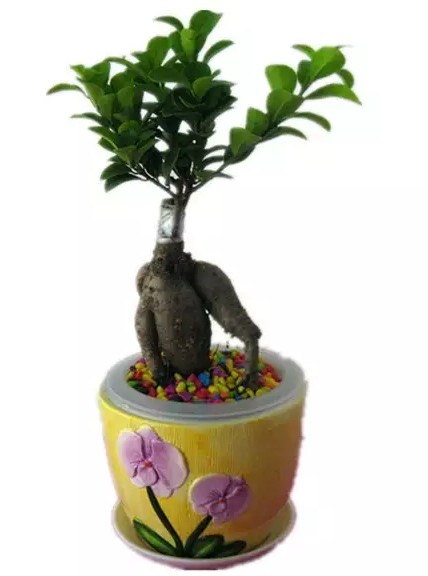
Ficus leaves are rather large, and the roots are unusual, and no one has been seen making a forest-style bonsai with ficus either. Some bonsai enthusiasts often make use of the ficus's soft branches and trunk, thick and long roots, and strong adaptability to create bonsai in styles such as curved-trunk, slanting-trunk, cascade, tree-on-rock and raised-root. Ficus leaves are generally rather large and not attractive enough, so their growth should be controlled; besides spraying the leaves with water less often, the leaf-plucking method can also be used to make the leaves smaller. In the south in March, and in the north in April, cut off the tips of the branches, then cut the leaves off at the petiole.
Pinching:
To restrain the height growth of a tree bonsai and encourage the side branches to develop flat and spreading, the tender tips of the branch shoots can be pinched off.
Bud plucking:
When many adventitious buds grow at the base of or on the trunk of a tree bonsai, they should be plucked off at any time, so as to avoid the sprouting of forked branches that would spoil the beauty of the tree's shape.
Leaf plucking:
For foliage bonsai, the ornamental period is often the time when new leaves sprout; for example, the new leaves of maples, pomegranates and others are red, and through leaf-plucking treatment the tree can be made to put out new leaves several times a year, bright and pleasing to the eye, enhancing its ornamental effect.
Branch pruning:
Tree bonsai often put out many new branches; to keep their shape beautiful, attention must always be paid to pruning the branches. The pruning method should be decided according to the tree's shape; for example, for a cloud-pad style, the branches are pruned into a flat, even form. In general, dead branches, parallel branches, crossing branches and the like that spoil the appearance should all be cut off in good time.
Root pruning:
When repotting, combine it with root pruning; roots that are too dense or too long should be trimmed, and this can be considered according to the following situations. If the tree's new roots are poorly developed and the root system has not densely covered the bottom of the soil ball, the original pot can still be used for repotting and the roots need not be pruned. For tree species with well-developed root systems whose fibrous roots densely cover the bottom of the soil ball, a slightly larger pot should be used, the dense roots thinned out, the old roots removed, and a few new roots kept when repotting. For some old-stump bonsai, the roots can be appropriately raised when repotting to increase their ornamental value, and the old roots and the end portions of the roots trimmed away, then filled in with loose, fertile soil to encourage new roots.