How to achieve harmony when styling tree bonsai
In the creation of tree bonsai, a bonsai worthy of being called an excellent work must have all its parts integrated into one body, unified and harmonious. Otherwise, it is not a good work. In styling, the various ornamental parts of the bonsai, including trunk, branches, leaves, flowers, fruit and roots, should be mutually unified and harmoniously developed. That is, its form, volume, colour, lines, form and style, etc., require a certain degree of identity, similarity or consistency, giving people a feeling of unity and harmony. A successful bonsai styling work must form complex variations into a high degree of unity. Only in this way can it form a “harmonious” artistic whole. The sense of unity in bonsai styling should strive for: unity of artistic conception, unity of form, unity of materials, unity of technique, unity of lines, and unity of part and whole. Only in this way can unity and harmony be achieved. Therefore, in styling, attention should be paid to:
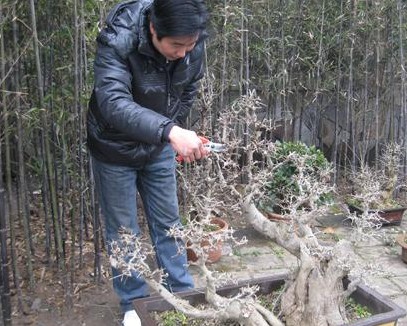
(1) Harmony of style and posture
In order to achieve harmony of style and posture, special attention should be paid to the following aspects in styling:
(1) Centring on the theme, highlighting the artistic conception, and harmony of style. The styling of each part of the tree - trunk, branches, crown and roots - must be coordinated and consistent.
This coordination must have a unified standard, and that standard is the theme, is the artistic conception. For example, to express an image of antiquity, age, disease and disability, showing tenacious vitality that has endured the vicissitudes of time yet retains rustic antiquity, one can make a rotted-trunk style (withered-trunk style) bonsai. The main trunk should show bark peeling and falling off, with the xylem exposed in many places, on which there are grooves, channels, holes and cavities formed by decayed xylem, as well as various knobs and scars. The bark of the branches is aged and full of twists and turns. The overall branches and crown are relatively light and simple, to match the aged appearance. The roots should match with exposed sinews, a coiling dragon root or radiating coiling dragon roots possessing an air of antiquity. In this way, the overall styling is well matched and coordinated. Making the main image distinct and prominent is one of the keys to the success or failure of the work.
(2) The posture of branches, crown and roots coordinates with that of the main trunk. With the main trunk as the foundation, all parts coordinate with one another. The work should be based on the style of the main trunk, and other parts should submit to the main trunk and serve it. Only by making the main trunk run through the whole can complete harmony be achieved and the overall effect be highlighted in one continuous sweep.
For example, if the main trunk is in the formal upright style, it has the artistic connotation of being tall, straight and majestic. Therefore, all the elements of each part should be styled and combined around this characteristic. If vigorous deer-antler branches or chicken-claw branches are used, with radiating roots like steel claws, and an upward fan-shaped crown is adopted to match the main trunk, then the whole tree appears coordinated and consistent.
Another example is the curved-trunk style bonsai. If the styling of the main trunk adopts the techniques of “storing branches and truncating the trunk” and “using a side branch to replace the trunk”, the main trunk is curved with clear order. Therefore, “firmness” is its main characteristic. Then its side branches should also adopt firm and powerful “zigzag branches” to coordinate with the main trunk. But one must never adopt soft, predominantly curved branches, lest the basic principle of harmonious development be broken (see Figure 4—1).
(3) The posture of the main tree and the companion trees, of trees and accessories, and of the individual and the group coordinates with one another. In a two-trunk five-needle pine bonsai, it is of course coordinated when the two straight trunks extend in the same direction, but in deciduous-tree two-trunk styles, a layout with one trunk straight and one slanting also counts as naturally coordinated (see Figure 4—2). In forest-style bonsai, a forest style in which the main trunks are all straight is coordinated, while in deciduous-tree styles a radiating layout with the main tree's straight trunk as the centre and the other trunks slanting outward also counts as coordinated.
In clump-style bonsai, the trees selected should be large and small, tall and short, straight, slanting and curved. In this way, through combination, harmony of height, harmony of size, harmony of straight, slanting and curved, harmony of density and harmony of concealment and exposure are achieved. The main tree and companion trees are brought into harmony and coordination, with a unified style and natural posture. And for a forest style of four trees or more, splitting into 2—3 groups for planar layout also counts as coordinated layout.
In addition, when adding accessories in bonsai styling, the form of the accessories must be unified and coordinated with the expressive intent of the main tree, so that they serve the main subject. They must not overshadow the host and destroy the overall image design.
(4) Harmony of style among the scene, the pot and the stand. When selecting a pot and stand for bonsai styling, the scene must be the centre, and the pot and stand must closely cooperate with it, playing a role of setting off and heightening; they must cooperate well with the scene and share the same style. For example, a flat, long pot is suitable for setting off formal upright, slanting trunk, double trunk, forest style and other bonsai; a tall pot is only suitable for cascade-style bonsai; and curved-trunk style bonsai sometimes looks more perfectly matched with a medium-tall round-arc pot. Matching a formal upright style with a flat, long pot makes one horizontal and one vertical, one moving (the tree) and one still (the pot) contrast with each other, full of harmonious and graceful charm. But if matched with a medium or tall pot, that contrast of one horizontal and one vertical is lacking, and the imposing upright momentum is also severely weakened (see Figure 4—3). For the selection of stands, “same shape, same match” is the most coordinated and unified. For example, a round pot with a round stand, a square pot with a square stand, a tall pot with a tall stand - consistency of shape makes harmony of style easy.
(2) Harmony of proportion
Proportion is an important factor in the aesthetics of tree bonsai; the “inch” in the saying “shrinking the dragon to an inch” explains the principle within it. For tree species and forms of the same specifications, if the proportions are not coordinated, the artistic effect will be greatly weakened. Proportion runs through the entire process of bonsai styling, including the ratio of size, of height, of thickness, of length and so on. Examples are listed below:
(1) Harmony of the proportions of the main trunk. This mainly includes harmony of the proportions of the parts of the main trunk itself, and harmony of the proportions between main trunks. For example, the main trunk itself should be thick below and thin above, with a natural transition. At the bends of the main trunk, the sections become shorter one by one from bottom to top. With two trunks or more, the main tree's trunk should be thick and tall, while the companion trees are relatively shorter and smaller. In forest-style bonsai, the front should be large and the back small. That is, the near view should be large and the distant view small. In the two-trunk style, the ratio of the height and the spread width of the branches of the companion tree to those of the main tree is more suitable at 0.5—0.8. The volume of its crown should also be such that the main tree is larger than the companion trees, which is more suitable.
(2) Harmony of the proportions of branch pads.
① The spacing between branch pads is long below and short above.
② The length of side branches is generally long below and short above, and the position of the main branch pad should generally be born at the first branch pad in the lower part.
③ The thickness of branch pads is thick below and thin above.
(3) Harmony of the proportions of branches and trunk.
(1) The height of the position of the first branch pad coordinates with the height of the whole tree; generally, in the formal upright style, the height of the first branch pad should be more than one third of the tree height.
② The thickness of the first branch pad is suitably about one third of the thickness of the main trunk at that point. The further up, the closer the ratio of thickness between branches and trunk.
(4) Harmony of the proportions of the sizes of pot, stand and scene. Although the matching proportions of different bonsai styling forms and pots differ, visually speaking, if the pot is too large the tree appears short and weak. Conversely, if the tree is large and the pot small, it appears top-heavy and very unstable. Generally, when formal upright, slanting trunk and other styles use a flat, long pot, the length of the pot is suitably about two thirds of the spread width of the whole tree's branches (see Figure 4—4). The size of the stand should be determined by the pot: a long pot means a long stand, a short pot means a short stand (see Figure 4—5).
(5) Harmony of the proportions of accessories. This includes both harmony of the proportions of accessories and trees, and harmony of the proportions among accessories. A painting treatise says: “Ten-foot mountains, one-foot trees, one-inch horses, one-tenth-inch people.” Bonsai should likewise pay attention to proportional relationships; if accessories are too large, the originally lofty trees of the artistic conception become relatively small. At the same time, accessories should likewise grasp the perspective principle of near large and far small.
(3) Harmony of colour
For harmony of colour in tree bonsai styling, attention should mainly be paid to the following aspects:
(1) Harmony of colour among different trees. In two-trunk, three-trunk or forest-style bonsai, the same tree species is generally mostly used. In this way, different trees not only have similar postures but also coordinated colours. If tree species of different colours are used in a forest style, there must be a principal and subordinate relationship; the guest trees only play a decorative and complementary role, and must never reverse the roles of guest and host and destroy the harmony of colour.
(2) Harmony of pot colour and tree scene. When choosing a pot, the choice of colour must coordinate with the tree. For aged trunks and peeling bark, deep and rustic pot colours are generally used. For tree scenes with light-coloured branches and leaves and delicate, slender postures, light, plain and simple pots should be chosen. In flower-viewing and fruit-viewing bonsai, those with deep-coloured flowers and fruit should use light-coloured pots, while those with light-coloured flowers and fruit should use dark-coloured pots.
(3) The colour of accessories should be in harmony with the scene and pot, but the colour of small accessories should differ from the colour of the scene and pot. In short, it should not be too cluttered and dazzle the eyes.