Detailed Explanation of Pruning Techniques for Boxwood (Buxus sinica) Bonsai
Boxwood bonsai materials are mostly taken from wild old stumps growing by the water. With their small evergreen leaves and slow growth that is not easily deformed, they have become artistic treasures. Purple clay pots are commonly used, with pot colors mostly purple or light yellow. The pot shape is determined by the styling form: for cascade style, a deep cylindrical pot is suitable; for slanting style or curved trunk style, an oval or rectangular pot is used.
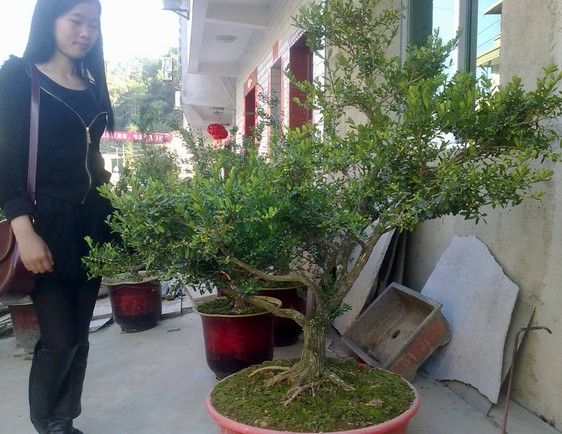
The main trunk of the Boxwood (Buxus sinica) bonsai grows extremely slowly and is very rugged and vigorous, but the young branches grow relatively fast, and the leaf density is inevitably stretched out, making it look soft and loose. Only by using "pinching" to control it can its ornamental value be ensured.
That is, before the branches have become woody, keep one pair, or at most two pairs, of young leaves and remove or cut off the rest. Under appropriate conditions of water, fertilizer, and so on, it will send out two young buds in ten days to half a month.
Going on in cycles like this, its branches appear short and thick, and the leaves can multiply by a factor of 2, continuously improving the ornamental value. Another point is to promptly remove the flower buds.
The Boxwood (Buxus sinica) begins to have flower buds before summer and autumn, and blooms in spring. The nutrients needed for flowers and fruit account for 70%-80% of the whole tree, which will inevitably affect its normal growth and appearance.
Boxwood bonsai is mainly grown for its foliage, so from the moment flower buds appear, they must be removed. Styling should be mainly done by pruning.
The wood of the Boxwood (Buxus sinica) is hard and brittle, and the bark on the branches is thin and easily damaged, so it is not very malleable. Therefore, attention must first be paid to selecting the stump, and then, adapting to the tree and guiding it according to its tendencies, styling must be mainly done by pruning.
Rope tying and pulling can also be used appropriately. Branches that need large position changes should be brought into place over several sessions; one should neither be overly demanding nor rush for quick results, otherwise the result will be the opposite of what is desired.
Do not use rusty iron wire to twist branches: first, to prevent damage to the bark; second, to prevent branch death.
Most roots need to be shortened. The Boxwood (Buxus sinica) has fine fleshy roots. Its water and nutrient absorption mainly depends on the absorbing function of the root tips, and the length of the root sections is secondary. If the roots are left long, they cannot spread out in the pot. Bending and crushing them is extremely harmful. Moreover, in order to absorb nutrients, the root tips will naturally extend forward and contact the new soil. If the roots are left long, before long the root tips will hit the wall. Although the root tips will turn, it takes effort and time and affects growth.