How to cultivate Chinese holly bonsai? Detailed practical technical points
Chinese holly, also known as tiger thorn, cat thorn, bird's perch, and so on, is a relatively common landscape tree species, often used in garden design and urban greening. However, because Chinese holly has relatively high ornamental value, many people now also use it for bonsai artistic shaping and pot cultivation. Compared with Chinese holly grown in the ground, pot-grown Chinese holly is easier to keep alive, and there are also relatively fewer points to pay attention to during cultivation.
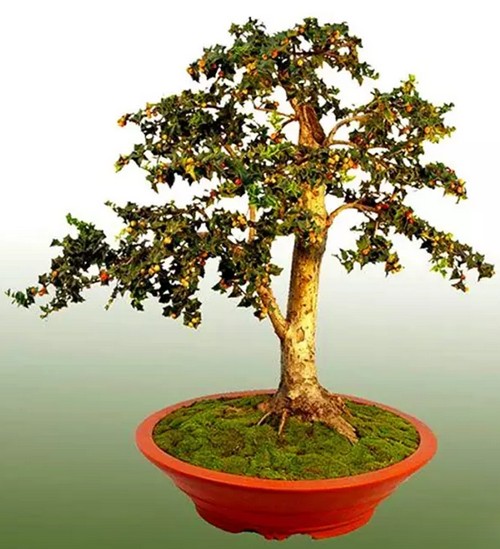
Chinese holly was originally mostly used to decorate roads, parks, courtyards, and other places, but now it can also be used for pot cultivation, as an indoor potted ornamental plant to enhance the indoor appearance.
Artificial propagation: mainly by seed propagation, and cutting and tiller propagation can also be carried out.
The fruit matures in November. After harvesting, pile it up, wait for the fruit skin to soften, then mash it, rinse it clean, and take out the seeds. Chinese holly seeds must germinate for 2 years. A low-temperature wet sand treatment can be used for one year. During sand storage, turn and mix once every two months to maintain a certain humidity and prevent the seeds from spoiling. Sow the seeds in the winter of the following year, with a row spacing of 15-20 cm for drilling, a sowing depth of 2-3 cm, covering with 1.5 cm of burnt soil, and then covering with rice straw.
In March, they can sprout and emerge. Remove the straw in time and set up a shed for shading. Usually pay attention to watering, topdressing, weeding, and loosening the soil and other management work. The seedlings grow relatively slowly. Leave them in the seedbed for 1-2 years before transplanting separately.
For cutting propagation, in mid-to-late June (the plum rain season), select semi-ripened branches of the current year as cuttings. The length should be enough to include a heel (with part of last year's old branch), keep 4-6 leaves, insert to a depth of 12-23, water thoroughly after inserting, set up a shed for shade, water frequently at ordinary times, and B B keep the soil moist. After rooting, strengthen seedling-stage management, leave them in the seedbed for 1-2 years before transplanting. The survival rate is relatively high when transplanting in spring. Digging up root tillers for propagation is also possible.