A Complete Guide to Bonsai Pruning Techniques and Methods
A tree-stump bonsai that has already been shaped by wire training or that has naturally good form will often grow many new branches. To maintain its perfect posture, the bonsai must be pruned regularly; otherwise it will gradually lose its layers, become out of proportion, and its tree form will become disordered.
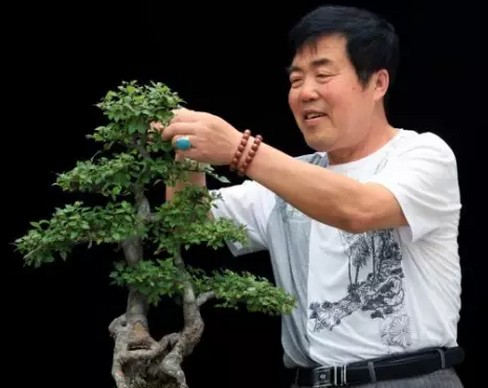
1. Promptly prune away useless branches. Generally, any crossing branches, parallel branches, wheel branches (that is, branches growing in a whorl on all sides at a certain point on the trunk), diseased or pest-infested branches, and all branches that detract from the appearance should be cut off as soon as they are found. This not only maintains the bonsai's original posture, but also helps regulate the reasonable supply of water and nutrients, so that flower-viewing and fruit-viewing bonsai bloom continuously and bear abundant fruit year after year.
2. Pruning of broadleaf species. Generally, broadleaf species such as Chinese elm (Ulmus parvifolia), Japanese bush cherry (Sageretia thea), and firethorn (Pyracantha) have relatively strong sprouting ability. After shaping, if they are allowed to grow naturally, many new shoots will emerge at the top of the crown, and the method of pinching should be used at any time to trim them flat and even, so as to maintain the bonsai's original layers and posture. This pinching and short-cutting work needs to be carried out 3 to 4 times each year. As for root suckers, and lateral buds and adventitious buds on branches and the trunk, they should be cut off or rubbed off promptly once they sprout.
3. Pruning of coniferous species. For coniferous species such as five-needle pine (Pinus parviflora), Huashan pine (Pinus armandii), black pine (Pinus thunbergii), and Huangshan pine (Pinus taiwanensis), the main approach is to control branch elongation and prevent the needle clusters from becoming too dense through short-cutting and bud removal. The new shoots that grow after the terminal buds sprout generally grow very fast and often protrude beyond the root crown, ruining the tree form. Therefore, in April each year, remove 2/3 or all of the main buds on the lateral branches by hand; two weeks later, 2 to 5 secondary buds will sprout at the same time at the spot where the terminal bud was removed. These secondary buds disperse the nutrients within the plant, and their growth vigor is very weak, so they can maintain an even-headed, relatively flat and dense crown. Second-year lateral branches should also be appropriately short-cut; several new buds can sprout at the same time near the cut, which not only maintains the crown's original layers but also creates a full, rounded, and natural tree form.
4. Pruning of flower-viewing and fruit-viewing bonsai. Before pruning, you must first understand the flowering and fruiting habits of the species. For species that flower on short branches, the vegetative branches should be heavily pruned to encourage more axillary buds to sprout and form short branches; for species whose flower buds differentiate from terminal buds, the flowering branches should not be short-cut, lest the flower buds be cut off; for species that bloom in early spring, the flower buds on the branches were differentiated last year, so they must not be short-cut in spring; the correct pruning time should be after the flowers fade. For example, winter jasmine, Chinese rose, poinsettia, pomegranate, kumquat, and crape myrtle bloom on branches of the current year, so these bonsai should be heavily pruned during the dormant period, which can encourage new branches to sprout and increase flowering. As for spring-blooming flower-viewing bonsai such as Dwarf Flowering Peach, Japanese apricot, ornamental peach, and Genpei crabapple, which bloom on second-year branches, they should be pruned after the flowers fade, to encourage new shoots to sprout and form more flowering branches for the following year; never prune them heavily during the dormant period.
The cut face should, as far as possible, avoid the large surface and be cut at a 45-degree angle to the branch, with the leaf bud left on the upper side of the slanted cut. During the growing season, prune close to the leaf bud to help the wound heal. During the non-growing season, prune above the leaf bud.
1. Formative pruning
Formative pruning, that is, positioning pruning, refers to the first pruning in bonsai shaping, determining which branches at different positions to keep and cutting off the surplus branches. For tree stumps collected from the mountains and wild, after they are cultivated and survive, many branches sprout, and most of them must be cut off, keeping only the backbone branches needed for shaping; this is called positioning pruning. After positioning pruning, the number of branches, their positions, and the mutual distances between branches are determined, which directly affects the beauty of the tree bonsai's form. Therefore, before pruning, you should carefully conceive the design and consider the form of the tree shaping; as the saying goes, "the idea comes before the brush," and at the same time you must "have a fully formed plan in mind" before you cut. This is because the selection of branches depends on the establishment of the tree-view form. The branches kept should be robust in growth, with coordinated thickness from top to bottom, avoiding parallelism, symmetry, and overlap as far as possible, achieving an appropriate density, spreading up, down, left, and right around the trunk, and possessing dynamic movement.
2. Reduction pruning
Reduction pruning is a pruning method that shortens branches, and it is also an important measure for tree shaping and maintaining the tree view. In terms of shaping, reduction pruning makes the tree dwarfed, the branches full, with controlled thickness from top to bottom and varied curvature, so three points should be noted in shaping:
1) The transition ratio in thickness between the pruned branch and the upper branch section is appropriate;
2) When reduction pruning, keep the direction and angle of the buds well, so as to adjust the new branches' reasonable occupation of spatial positions;
3) In reduction pruning, the branch sections should be short rather than long; the first section of branch is longer than the second, and the second section is longer than the third. In terms of maintaining the tree view, for the vast majority of shaped foliage bonsai, the water sprouts produced each growing season need reduction pruning to maintain a beautiful posture.
Shaped pine and cypress bonsai mainly rely on bud pinching and pinching out the growing tip to control overlong branches and maintain their original appearance. As for the reduction pruning of flower-viewing and fruit-viewing bonsai, different pruning methods should be adopted according to their different growth habits. For example, crape myrtle, pomegranate, and crabapple bloom and bear fruit on newly sprouted branches of the current year, so they can be reduction-pruned during the dormant period, but not during the growing season. Early-spring bloomers such as winter jasmine, Japanese apricot, and ornamental peach should be pruned after flowering, which can promote the formation of flower and fruit branches the following year.
Foliage bonsai can be reduction-pruned twice, in early summer and early autumn, and heavily pruned during the dormant period to remove all kinds of undesirable branches. Firethorn and Chinese holly (Ilex cornuta) bloom and bear much fruit on short branches; in addition to heavy pruning during the dormant period, the long branches of the current year can also be reduction-pruned in late spring and early summer, with frequent light fertilizer application and increased light, to encourage short branches to grow in summer and autumn and increase the amount of flowers and fruit. Heavy pruning during the dormant period must appropriately retain short branches to ensure the flowers and fruit of the following year.
3. Thinning
Thinning maintains the tree's landscape and can increase ventilation and light penetration, reduce the occurrence of pests and diseases, concentrate nutrients, and promote luxuriant branches and leaves and abundant flowers and fruit.
The timing of thinning varies according to whether it is heavy or light pruning. During the growing season, when branches and leaves are luxuriant, light pruning can be done at any time, but heavy pruning is not advisable. For species with strong sprouting ability, such as Japanese bush cherry and elm, heavy pruning can be carried out while avoiding the plum rain season. After pruning, reduce the amount of watering, apply frequent light fertilizer, and strengthen light. Generally, the amount of thinning at the upper part of the tree can be greater and at the lower part smaller, because lower branches are harder to grow. The objects of thinning are mainly all kinds of undesirable branches, as well as overly dense crown parts. When the upper and lower crown parts are equally important, keep the lower and cut the upper as far as possible, so that the volume of the upper crown is smaller than that of the lower crown. After thinning, the growth of the crown is suppressed, and many new branches will sprout, which should be cut off promptly. Pruning methods also include bud removal, pinching out the growing tip, and leaf removal:
1) Bud removal: For tree bonsai species with strong sprouting ability, during the growing season, buds sprout both abundantly and quickly, so all unwanted buds must be promptly removed tirelessly, including root buds, trunk buds, and axillary buds. At the same time, pay attention to retaining the direction, position, and density of the buds, so as to avoid sprouting forked branches, opposite branches, and overlapping branches that affect the beauty of the tree form.
2) Pinching out the growing tip: That is, removing the tender tips of new shoots during the tree's growing season, inhibiting excessive elongation of new shoots, promoting the growth of lateral branches, and shortening the branch nodes, so as to maintain the beauty of the tree form. The timing of pinching out the growing tip differs according to the different sprouting periods of different species. For foliage bonsai, pinch out the growing tip once the new leaves have unfolded 2-4 leaves. For flower and fruit bonsai, it should be handled flexibly according to the different flowering and fruiting periods. Pinching out the growing tip can stimulate the growth of lateral branches and increase the amount of flowering.
3) Leaf removal: Appropriate leaf removal can make the leaves smaller and improve the ornamental value of the bonsai. Some people call this method "taking off the clothes and changing into brocade." Generally speaking, the new leaves that sprout in spring are the most attractive; as the season progresses and with summer exposure, the originally glossy, brightly colored leaves gradually become dull and aged. Through leaf removal treatment, fresh and tender new leaves can be produced once again, adding another period of the best ornamental effect. Some old stumps, with iron-like branches and gnarled trunks, majestic and sturdy, and new leaves like jade, green and dripping, present a scene full of vitality in spring. The timing of leaf removal varies with the species; foliage species can have their leaves removed in early summer or early autumn. Evergreen trees should not have their leaves removed. During the leaf removal period, water should be appropriately withheld, and the potting soil should not be too moist; in addition, frequently apply decomposed cake fertilizer water, and strengthen ventilation and light, to promote the sprouting of new leaves.