Detailed explanation of crabapple bonsai seedling cultivation techniques, easily grow high-quality bonsai seedlings
The 'Radiant' crabapple (Malus 'Radiant') is a deciduous tree. The tree form is compact, turning brown-red, with pink flowers. It is mainly an ornamental plant. After the flowers fall, the ground is covered with purple petals, colorful and splendid.
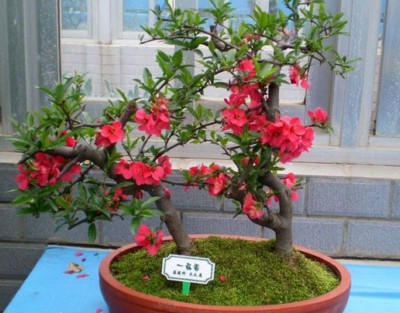
This variety has abundant and gorgeous flowers, early fruit coloring, and can be enjoyed for its fruit in summer. It is cold-resistant and disease-resistant, and can be widely used in landscape design. It is one of the best-performing modern ornamental apple varieties in Beijing, and is very suitable for the dry northern environment of China. It is suitable for solitary planting or planting beside rocks and water. The fruit is small and numerous, crystal-clear and lovely, with a long fruit-viewing period. It is a famous ornamental tree species in northern China. In royal gardens, it is often planted together with magnolia, peony and osmanthus, taking the artistic conception of “Yutang Fugui” (jade hall wealth and honor). Crabapple flowers are planted on both sides of sidewalks, around pavilions, at the edges of groves, and beside waterside pools. Crabapple flowers have strong resistance to sulfur dioxide, and are used for urban street green spaces and mining area greening.
Crabapple bonsai is mainly propagated by sowing and grafting, and can also be propagated by root cuttings, division or layering. Seed-grown seedlings from sowing bloom relatively late, generally requiring seven or eight years to bloom, and cannot maintain the excellent characteristics of the original variety, so grafting is usually used for propagation. Grafting mostly uses seedlings of wild crabapple (Hupeh crabapple, Malus hupehensis) or Siberian crabapple (Malus baccata) as rootstock, and is carried out by cut grafting in March.
For bonsai grafting, graft as low as possible. Select excellent varieties for the scion, using robust and plump one-year-old branches, taking the middle section with 2 plump buds. If the scion collected before grafting is not used temporarily, it can be stored buried in moist sand.
For cut grafting, cut off the rootstock at 3-5 cm above the ground, gently make an upward slanted cut from one side of the cut, then from the cambium at the slanted cut area of the shoulder, cut downward 1.5 cm slightly with wood, keeping it vertically downward without tilting. Then vertically cut the lower part of the scion on one side slightly with wood to 2 cm, and make a steep slanted cut on the opposite side. Insert this scion into the cut of the rootstock, so that the cambium of the rootstock and scion are tightly joined. Bind the joint firmly with plastic film strips, water thoroughly at the roots, and provide shade.
This grafting method has a high survival rate, and the joint heals easily. After successful grafting, new branches emerge, and with proper management, they can reach 80-100 cm in height in the same year. In winter, cut off the top shoot, leaving 3-5 main branches to encourage branching.
In the second winter, cut off the tops of the main branches again to develop scaffold branches, which can form a neat tree shape and is conducive to flowering. Bud grafting is carried out in June-July, and the survival rate is also relatively high. Root cutting propagation is carried out in spring from February to March, selecting tender roots with a diameter within 1 cm and a length of 6-7 cm, inserted to a depth of more than 2B3, with the tip able to emerge from the ground. Loose, fertile, well-drained sandy loam is suitable, and survival is also relatively easy. Using crabapple root suckers for division planting is also possible, and can advance flowering.