A Detailed Explanation of the Styling Methods and Techniques for the Cascade-on-the-Ground Style of Bonsai
The cascade-on-the-ground style and the slanting style are related; the so-called kinship only refers to the related effect of one following on after another. If a slanted tree cannot be fixed and stabilized, it will eventually topple over completely because of loss of balance. In woodland areas, large trees of this kind of form are generally commonly seen lying across the ground.
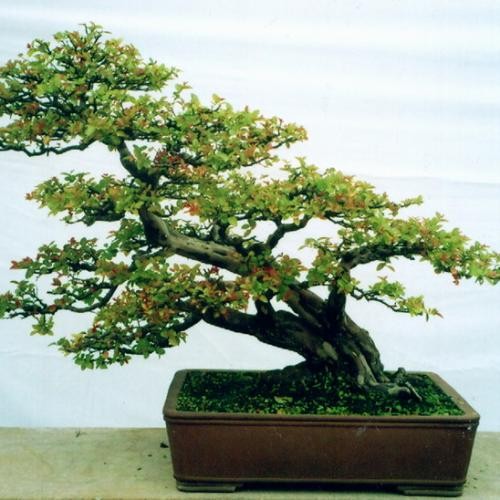
Speaking of this, I would like to talk about a digression. Many people have not clearly understood the artistic value of bonsai. Although bonsai is a kind of work that is never completed, its ornamental value still has certain standard factors. Surely it is not that a fallen, lying tree just knocked down by a storm has beauty or something worthwhile? Must this be used as an example? Readers must be puzzled in their hearts, shouting inwardly, No! No! Of course, readers are so shrewd, so let me show off my slight skill before an expert and do a bit of talking.
The so-called cascade-on-the-ground, besides lying on the ground, must also possess that vitality of coming back to life. That is to say, the purpose of this form is to present a tree that fell because of natural factors struggling for a period of time and then flourishing again; the image at this time is the essence of the cascade-on-the-ground style! The so-called artistic value of bonsai refers to this kind of reasonable form. Therefore, before getting back to the main subject, I also want to discuss the wind-blown style that is currently popular in bonsai circles.
The so-called wind-blown style is when a bonsai appears to be struck by fierce wind and rain and to be struggling against it. At first glance, there is nothing wrong with this picture, but just think: that static movement is not suitable for this three-dimensional and active art of bonsai, because the value of bonsai is entirely people-centered, and only then does it possess humanistic value as a field of learning. If a static tree form in a storm were expressed through photography, I believe everyone could accept it; after all, photography belongs to static presentation. But if it were replaced by today's video technology, it could not be accepted, because forward-moving operation does not allow part of it to be static while the rest is dynamic. Bonsai is an art creation of the dynamic type, so from the very beginning it differs from other arts. It is an art with no end. Often, completing a single bonsai work may take decades. If too many unreasonable forms are allowed within it, or if clever shortcuts, sensationalism, deceptive methods, and other quick-fix, obscuring self-justifications are permitted, the art of bonsai can never reach the level of a national treasure.
Therefore, I, who dearly love the essence of ancestral culture, absolutely will not allow erroneous ideas contrary to correct bonsai to continue existing. For example, the wind-blown style mentioned above, incorrect proportions of the plant, trees showing shrub habits, cliff forms with crowns and caps on top, and even many other things too numerous to mention, such as giant trees with raised roots, unbalanced layouts, random combinations of forms that cannot appear in natural forms, and oversized, overly thick dimensions exceeding extreme standards. These errors truly await further awareness and correction by the broad masses, so that the art of bonsai can truly stand firm in its own position, leave a genuine skill and learning for the descendants of the Yellow Emperor, let international colleagues behold the bearing of a great nation, and prove the foundation that the motherland of bonsai should have.
As for the cascade-on-the-ground form, it is one of the forms favored by our nation. In many paintings by ancients, it is common to see three or five pines and cypresses gathered standing on a small mound, among which several upright-trunk literati types are often painted, paired with one or two cascade-on-the-ground or slanting trunks to indicate a forest area. From this simplified layout, one can understand the remote orientation of Chinese culture.
The image of the cascade-on-the-ground is quite like the lying arhat painted in ancient paintings, with gnarled roots and intricate twining, and a thousand moods and appearances. Especially that arhat venerable with angry eyes and horizontal brows, his whole body covered with crisscrossing textures; although sleeping and lying across, he is still irresistible. The overall momentum surges, and although silent and motionless, he still possesses abundant strength, ready to move at any moment.