How to shape a formal upright bonsai? Detailed methods and techniques
The formal upright style is the most common form in bonsai creation, because the vast majority of bonsai materials can be made into the formal upright style, especially collected tree material, which is found everywhere. However, creating an excellent formal upright bonsai is truly not easy, since it is hard to find material of superior quality when collecting from the wild. Either it is tender and young with no trace of age, or it is straight as a pillar, or worse still, uniform in thickness from top to bottom, looking exactly like a small tree in nature.
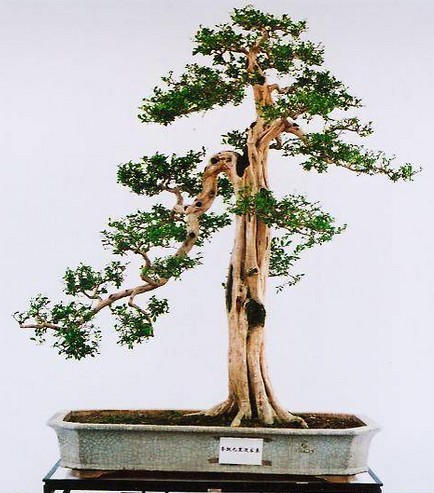
Therefore, the formal upright style can be described as a form that is easy to make but hard to master. Following the approach of Qinglong Bonsai, seedlings grown from seed, that is, material propagated from seed, are the first choice, because the natural forms created by natural law all come from natural seedlings, without any human assistance such as other propagation methods. Thus seedlings are also the only excellent starting point closest to natural conditions.
Although the trunk of a large tree in nature may appear straight, a careful analysis shows it is not entirely straight. In painting theory it is said that a tree has not an inch of straightness, which shows that it appears straight but is not wholly straight. Within this there is much worth savoring, much cultivation and momentum to ponder, and those traces of time carved by environment, nutrition, water supply, sunlight or insect damage twist the whole trunk like a candy twist, displaying full vigor. This is the true spirit of the formal upright style. That tall, towering, incomparably majestic bearing is what matches using simplicity to express complexity, embracing the origin and holding to the one, and raising a plain and unremarkable formal upright form to lofty praise.
However, how can one achieve an inner substance and outer strength, standing tall and rising from the ground with momentum like a rainbow? Apart from occasionally collecting one or two fine pieces from the wild, in essence one must rely on effective production methods to make up for the high demand. Otherwise, to seek one fine work, one would dig through entire mountain ranges, and even then it would not help.
Qinglong Bonsai is a comprehensive craft rooted in technique, centered on culture, emphasizing environmental protection and scientific progress, and worthy of wholehearted commitment by anyone interested. According to the working style of Qinglong Bonsai, seedlings are selected and wrapped with wire from a young age. Since the trunk will stand upright in the future and little variation is required, the method differs slightly from that of other styles. The seedling should be shaped and bent as young as possible, and the distance between bends should be small and varied, striving to keep the angle at around ninety degrees. If it is a literati tree form, it should not exceed seventy degrees, otherwise it would belong to the slanting style.
The formal upright style can basically be divided into two forms with different appearances. The large, tall and towering thick-trunk type emphasizes wrapping from a young age, then undergoing years of container cultivation or ground cultivation in semi-wild conditions, with regular heavy pruning to build the trunk, until it reaches more than half to eighty percent of the expected thickness, only then keeping the main branches and wrapping them to fix their shape. After one or two years of semi-wild cultivation of the main branches, fine wrapping of the small branches begins, along with leaf trimming and momentum control, until the overall shape is completed. Subsequent management likewise follows a systematic schedule of regular work.
The literati type, by contrast, involves years of container cultivation and meticulous management, not seeking domineering majesty or power over all, but cultivating only a proud, aloof bearing and a unique temperament standing out among the flowers. Its creation also uses metal wire wrapping to fix the shape, but it strives for concision and elegant simplicity. To borrow a phrase from painting theory, it must achieve little ink yet seem like iron brushwork and silver hooks, with every branch showing a stroke of divine inspiration. Therefore, the market all says that the literati tree form is the highest realm of Chinese bonsai. Unfortunately, those who know it is so but not why it is so are exceedingly numerous throughout the world.