Detailed Explanation of the Shaping Techniques and Methods for Cascade-Style Bonsai
Cascade style can be considered the style that bonsai artists favor most in the bonsai world, yet they often find their ability falling short of their wishes, finding it difficult to express the unique character of cascade forms in nature. What is the reason? Based on my personal exploration over many years, the main reason ordinary artists rarely produce even one or two fine pieces is none other than their reliance on excavating natural material. After all, small trees in nature that possess superior qualities are rare, let alone when what is required is a cascade-style bonsai with highly varied shaping.
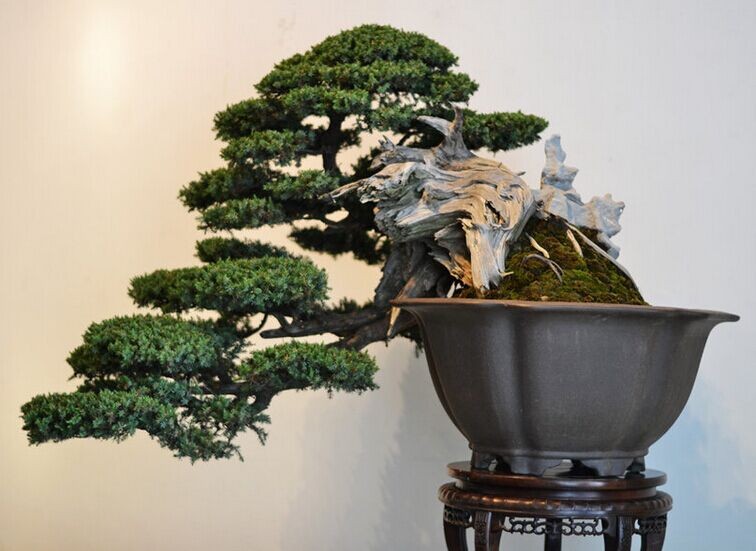
However, Qinglong Bonsai has always created bonsai by wrapping and shaping from a young age, so it is inevitably twice as effective with half the effort compared with ordinary production methods, and it is also a surefire way of doing things with ease. This is because the cascade tree form is a form of existence in relatively special environments in nature; it is not the habits of the variety that influence the orientation of the shaping, but rather the factors of environmental change that govern the variation in shaping. Therefore, before beginning the creation of cascade-style bonsai, it is necessary to first understand the process by which cascade forms arise.
The formation and occurrence of cascade forms are closely related to the environment. Generally, cascade-form trees all grow in harsh and perilous environments such as cliff faces and precipices. This kind of terrain is most prone to landslides or slight soil erosion over many years, so how could plants growing in such a changeable environment fail to adapt to circumstances and grow into the unique form that only such an environment can produce? That is the cascade form that took the world by storm.
The plant sprouts and puts out roots, and with the harsh environment of little rain and much wind, bit by bit it slowly penetrates and deeply anchors itself in that limited soil. Through long-term trends, it gradually grows and gradually lengthens, or a heavy rainstorm, or a night of wild wind, and the plant itself can no longer bear the increased weight, so it breaks and hangs down. This sudden variation may cause broken branches and split trunks, or the plant may simply fall to the foot of the mountain, not worth mentioning.
Thereupon, the plant still hanging at the edge of the cliff turns from strong to weak, and after another struggle, gradually takes shape. It often cannot withstand several rounds of wind and rain, and once again hangs upside down like a golden bell, repeating the same mistake. In this way, again and again it revives toward the sun, again and again it turns from vigorous to weak, cyclically hanging upside down and being reborn, with broken branches and snapped trunks, cracks and damaged sinews, gradually developing a body that is coiled, flat, and rigidly strong, creeping forward, like a coiled dragon dancing, with an endlessly varied bearing, and this is precisely the strength of Qinglong Bonsai.