What should bonsai styling be based on
Cultivating and creating bonsai is a topic that every participant is eager to discuss and interested in, but people often each go their own way, assuming they are right, and run into all kinds of doubts and technical deviations, so this chapter mainly focuses on discussing its scientific nature and rationality from a direct entry point, for everyone to make a preliminary analysis and study.
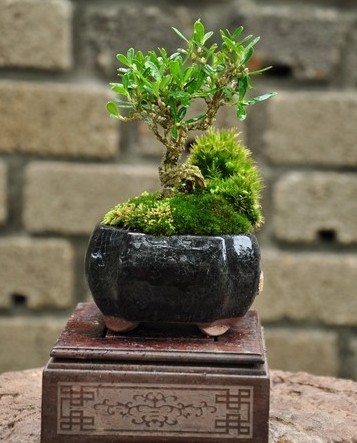
The styling of bonsai is formed according to the laws of nature and factors such as the geographical environment. Every bonsai has its own unique form, and these special factors will dictate the trend of its styling. In other words, what kind of environment will produce what kind of tree form. This point is beyond doubt. This involves dependence on sunlight, the flow of air and the characteristics of the variety. To make it easier to understand, let us discuss and summarize them one by one.
Bonsai has many styles. The more common ones include the formal upright style, the twisted trunk style, the curved trunk style, the slanting style, the semi-cascade style, the connected-root style, the group planting style and the cascade style. The cascade style can be divided, by the angle at which it extends beyond the rim of the pot, into the large cascade, the small cascade and the floating trunk style. The formal upright style, according to its thickness, is divided into the giant trunk style and the literati style. In fact, these basic styles only give everyone a preliminary understanding of the natural forms of bonsai and their range. If explored in depth, the same bonsai can also possess several styles at the same time and blend them together, presenting a special character. Works of this kind leave more room for appreciation. After all, the styles born of the natural environment are not a realm that ordinary bonsai makers can grasp, so once you understand them deeply, bonsai art will be a road of no return. It will endlessly let us experience the laws and changes of that vast universe in the natural world.
Although the changes in styling are unpredictable, they must conform to the growth pattern of the plant. This is a mistake that ordinary bonsai makers often make. Regarding this point, we can understand that although bonsai belongs to flower cultivation, it is deeply influenced by Chinese culture, so bonsai leans more toward creation in the cultural and artistic aspect. From exploring the history of bonsai, it is not hard to discover that the entire creative trend of bonsai has been influenced and guided by men of letters, so Chinese bonsai works lean more toward the expression of poetic and pictorial imagery, and because of this they often ignore its scientific nature and the plant's own growth habits. Those growth habits have patterns and are based on reasons. In particular, most trees in nature grow in clumps or grow according to environmental factors, so in principle plants are a combination that grows in groups and lives together, and they must naturally grow in keeping with the surrounding environment. However, the common presentation of bonsai takes a single isolated tree as the main subject. Therefore, when scientific theory cannot yet be established in the creator's consciousness, bonsai can only be specious, presenting problem-ridden bonsai styles while knowing that it is so but not why it is so.
However, when bonsai moves toward the world, toward the masses, and toward other peoples who likewise live on Earth but do not understand Chinese culture, its persuasiveness must achieve appeal to both refined and popular tastes and conform to the compositional elements of nature. Only in this way can it truly display the leadership demeanor of a major bonsai country and the birthplace of bonsai, especially before other countries have this level of understanding. We should spread it widely and effectively to every corner of the land of Shenzhou, first triggering a major academic reform within the country, adding dialectical examination to erroneous techniques, pooling collective wisdom and efforts, and under the great premise of discarding the dross and keeping the essence, integrating this traditional art of bonsai with the essence of other national treasures, to raise the existing level of bonsai skills more perfectly, so that when once again facing the world, the new bonsai techniques will have an overwhelming academic background.
The topic has wandered too far. Let us return to the scope of styling. I once said before that in creation one can present a bonsai with multiple features in the same work, but it must conform to the laws of nature and cannot be done arbitrarily. All self-created styles that violate the laws of nature cannot stand. For example, on the market one often sees cascade-style works with an extra layer of canopy near the tree stump, and in the field of bonsai this is a common mistake.