Detailed Explanation of Winter Pruning Methods for Fruit Tree Bonsai, Beginners Can Learn Too
Winter pruning, also called dormant-season pruning, refers to pruning during the dormant period from after the fruit tree sheds its leaves until spring flower buds begin to swell. The so-called “winter pruning keeps the tree vigorous” because at this time most of the nutrients have already been transferred from the branches and leaves to the main trunk and roots of the fruit tree for storage, so pruning causes the least nutrient loss to the fruit tree and less damage to the tree body. Also, because there are no leaves, it is easy to observe and analyze the canopy structure and predict the canopy shape after new shoots grow, which is helpful for shaping. Therefore, winter pruning is an important pruning period for fruit tree bonsai, and its main content and task is the crown shaping of fruit tree bonsai.
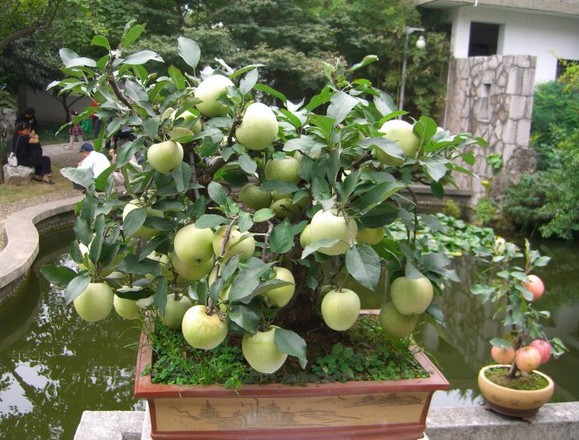
Renewal pruning Renewal pruning, abbreviated as heading back, means cutting off part of a perennial branch. The key to renewal pruning is to observe the thickness of the renewed branch and the strength of the branch at the cut, and to master the position of the reduction. For a bare-legged branch, renew it by leaving a horizontally extending or drooping branch at the cut, which can promote branching and achieve the effect of reducing height or shrinking the canopy. When renewing a perennial branch with branches, use the “swinging a small braid” method, that is, leave a short branch below the cut to strengthen the power of “controlling the front and promoting the rear” and speed up bud sprouting and growth of the rear branches.
Cut back a one-year-old or non-flower-bud-forming medium-slanting branch to the blind node (that is, the junction between the spring shoot and the autumn shoot). For strong branches, “wear a live cap” (leave several buds above the blind node); for weak branches, “wear a dead cap” (cut in the middle of the blind node, leaving no buds above). This can promote early fruiting; when growth and fruiting cause perennial fruiting branches or fruiting branch groups to droop and overlap, and together with the “peripheral advantage” the fruiting position moves outward year by year, the canopy becomes loose, strong outside and weak inside. By pruning and changing the leader, leaving an upward strong branch at the cut and raising the angle, the canopy can be renewed and rejuvenated, the canopy structure adjusted to make the canopy balanced and compact, and the canopy size controlled to achieve the ideal crown shape.
Thinning
Also called thinning pruning, that is, completely removing perennial or one-year-old branches from the base. It is mostly used for diseased and insect-damaged branches, dead and dry branches, fine and weak branches inside the canopy, densely clustered branches, crossing and overlapping branches, peripheral head-butting development branches, auxiliary nurturing branches, and worthless branches that are too straight or too vigorous and affect the tree shape or cannot be used, so as to improve ventilation and light conditions in the canopy, enhance light intensity, increase photosynthesis, and manufacture and accumulate nutrients.
Thinning has a weakening effect on the tree vigor of fruit trees. The larger the cut, the greater the weakening effect, so it must be considered as a whole. Specifically follow the principle of “thin the thick and keep the fine, thin the weak and keep the strong”; therefore, mastering the growth vigor and thickness of the branches being thinned and the amount of thinning is the key to thinning pruning. When the thinned branches are relatively thick and numerous, they should be thinned in batches: thin a few branches this year and a few more next year. Do not thin too many at one time, and do not cause “opposite wounds” so as to avoid weakening the fruit tree too much and causing decline and death.
Long pruning
Long pruning means delayed pruning or leaving branches unpruned, that is, not pruning part of the one-year-old branches and letting them continue to grow. The key to long pruning is to master the growth vigor and subordinate relationship of the long-pruned branches: when the skeletal branches are weak and the auxiliary nurturing branches are strong, long-prune the skeletal branches and control the auxiliary nurturing branches to weaken their growth vigor; when there are many long and vigorous branches and a relatively large amount is thinned at one time, a small number of long and vigorous branches can also be long-pruned, but this must be combined with summer pruning to control their growth vigor. If growth is still relatively vigorous in the second year after long pruning, short cutting or thinning can be carried out. After long-pruned branches bear fruit, renewal pruning or short cutting should be given according to different conditions such as tree species, variety, and growth vigor, so as to renew and rejuvenate.
Do not long-prune for consecutive years or only leave branches without pruning, so as to avoid causing a disordered crown shape and unclear layers. At the same time, dense branches are not conducive to ventilation and light penetration.
Short cutting
Short cutting can cause the lateral buds below the cut to sprout and promote branching.
According to the length of the branch cut off, it can be divided into light short cutting, medium short cutting, heavy short cutting, and extremely heavy short cutting. The reactions after pruning differ with the degree. Light short cutting leaves a long branch and many buds, nutrients are not concentrated, and it easily sends out more medium and short branches, which is beneficial to flower bud formation; medium short cutting leaves about two-thirds or one-half of the spring shoot, and after cutting it sends out more medium and long branches with relatively strong growth vigor, generally used for cultivating large branch groups or rejuvenating weak branches; heavy short cutting leaves a shorter portion, promotes fewer but stronger buds at the cut, and is suitable for cultivating branch groups or renewing branches; extremely heavy short cutting leaves an even shorter portion, leaving only one or two shriveled buds, has weak branching ability, and the branch position is low and close to the trunk, suitable for handling upright branches, water sprouts, and competing branches, making the canopy compact and facilitating canopy renewal.
When a fruit tree bonsai has too many branches, it is easy to cause situations such as dispersed tree nutrients, insufficient internal light, and poor fruit quality. Therefore, before fruit trees sprout in spring, crossing branches, overlapping branches, diseased and insect-damaged branches, and water sprouts should be cut off. This is basically consistent with the pruning of other clivia gardens and is called basic pruning. During the summer fruit growth period, tree shape is controlled through pinching, bud removal, short cutting, and other means, and the formation of apical dominance is prevented to promote fruit growth and swelling. In autumn, in order to improve the ornamental effect of fruit tree bonsai, shaping should be the main focus; branches that affect the ornamental effect can be cut off, and leaves covering the fruit can be removed.