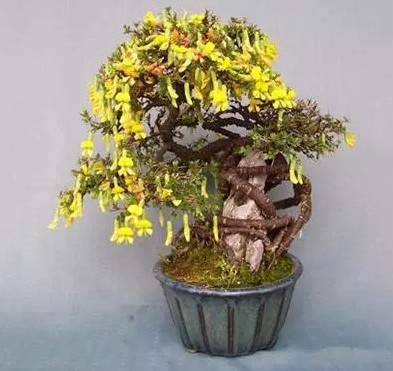
Cultivation methods and key techniques for Caragana bonsai
Caragana arborescens is generally propagated by sowing. Its seeds mostly ripen in early August; when the pods turn dark yellow they should be picked in time, for if picked too late the seeds will burst from the pods and scatter, making them hard to collect. Spread the collected seed pods in the sun to dry so the seeds shed naturally from the pods; after cleaning, put the seeds in a clean cloth bag and store them in a shaded, ventilated place. In mid-March of the following year, soak them in 45°C warm water for 48 hours, and then they can be sown.
Choose fertile, flat, well-drained sandy loam as the nursery site, and apply rotted and fermented cattle or horse manure as base fertilizer at 3500 kg per mu. The base fertilizer should be mixed evenly with the nursery soil, then after sun-drying, rake it fine and level it, and disinfect the seedbed with quintozene. Broadcasting can be used for sowing, with a seeding rate of 20 g to 25 g per sq m. After sowing, tread lightly with the foot and give one sprinkler irrigation.
During seed germination, keep the soil moist. After the seedlings emerge evenly, irrigate once every 5 to 7 days, each time watering thoroughly and deeply, and it is best to irrigate in the morning or evening. When the seedlings reach about 20 cm, thin them. Carry out thinning on cloudy and rainy days, and operate carefully to avoid damaging other seedlings.
To promote faster growth of the seedlings, apply urea once in mid-June and a phosphorus-potassium fertilizer once in early August, and water promptly after topdressing. After two years they can be transplanted.
It can be propagated by cuttings, division, layering, sowing and other methods, generally mainly by cuttings. In February to March, use hard wood from the previous year, or in the plum rain season use semi-ripe softwood of the current year for cuttings. Cut the cuttings into 8-12 cm lengths and insert them to a depth of 12; after insertion, B build a shade frame for shading and water moderately.
After rooting, remove the shade frame and give full light for robust growth, and the survival rate is relatively high. Division propagation is carried out in spring, in February to March. Sowing propagation is carried out in March to April; before sowing, soak the seeds in warm water (40°C) to promote germination, and the germination rate is high. For bonsai use, old stumps can also be collected from the wild to make shapes, with quicker results. Choose those that are old in appearance and have a single trunk, which are the best.