Detailed Explanation of Processing and Shaping Techniques for Honeysuckle Bonsai
Honeysuckle (Lonicera japonica) is a temperate and subtropical tree species. It likes sun but also tolerates shade, tolerates cold, tolerates drought and moisture. It is not demanding about soil and can adapt to both acidic and alkaline soils, but prefers loose, fertile, neutral sandy loam. It is vigorous, has a well-developed root system, strong sprouting ability, a light and graceful plant body, an elegant posture, and quaint old stumps, making it an excellent material for making bonsai.
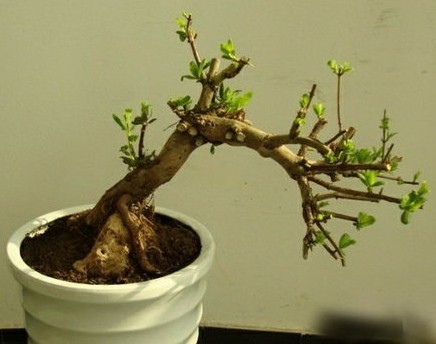
For the shaping of honeysuckle, wire training is the main method, combined with pruning. Wire training involves winding the main branches around each other and weaving them into a trunk so they grow as one, then carrying out further processing. Small branches are generally processed by pruning.
The shaping of the tree stump should be done according to the material and with ingenuity, and according to the material's characteristics. Honeysuckle is generally suitable for exposed-root style bonsai; it can be planted with the roots exposed when potting, or the roots can be raised 3-6 cm year by year when repotting. It is also possible to remove a tree stump that has been grown in a deep pot for many years together with the pot soil, without breaking the soil ball or damaging the roots, and plant it in a shallow pot slightly larger than the deep pot. Fill the surrounding gaps with nutrient soil, firm it, then use a hose to wash away the soil above the pot surface from between the roots. After the roots are exposed, cut off excess fibrous roots and it is done.
Honeysuckle bonsai shaping is mainly in cascade style or weeping-branch style, so that its innate dynamic posture can be fully expressed. Because its stems and vines have a left-twining habit, its trunk and branches can also be shaped in curved-trunk style, using the trunk-cutting and branch-growing method for pruning, but excessive shaping and pruning within one year should be avoided, otherwise flower bud formation will be affected. For branches that are not in place, moderate wire training and guiding can be used. After the branches become woody and set in shape, the wire should be removed promptly.
Use a natural style for shaping, so that the branches on the stump follow their natural tendency, droop smoothly, and are well spaced with appropriate density among branches and leaves. Reasonably use blank space to make it rich in pictorial quality and enhance its artistic beauty.