How to prune a honeysuckle bonsai? A detailed guide to practical techniques
Honeysuckle is naturally vigorous, and its stems can take root as soon as they touch the ground. It can be transplanted bare-root, and collected old stumps can easily survive cultivation even without fibrous roots. From the time of potting, carry out dwarfing, shaping and pruning to develop a thick trunk and short branches. During the growing season, remove vigorously growing buds, pinch the tips of strong branches early, and when pruning, cut long growth and keep short growth. Through shaping and pruning, it is encouraged to change from a climbing, twining vine type into a short-branched, dwarf-trunk bonsai shrub type with evenly distributed, densely arranged branches and clear layering.
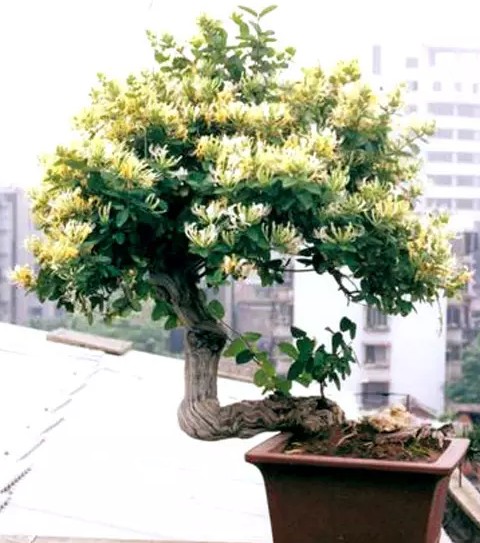
Honeysuckle has very strong sprouting ability, so pruning is very important. During the dormant period, cut off weak branches and all kinds of branches that affect the shape, and appropriately shorten healthy branches. After the first flowering, pinch the tips to promote a second flowering. After the branches are pruned, the buds that sprout are mostly flowering branches, and they generally bloom once they grow to 10-20 cm.
1. Root pruning
The root systems of honeysuckle stumps collected in the wild or dug from nurseries are often very long. When cultivating them, do not rush to cut them short; observe carefully and plan the design. The roots can often be coiled and shaped to replace the trunk with roots, and then, according to the size of the pot and the needs of cultivation, prune the root system appropriately before potting. Never use too much force or coil thick roots drastically, to prevent breakage. Handled this way, once formed, the roots become gnarled and interlaced, very pleasing to the eye.
2. Branch and trunk pruning
Honeysuckle grows wild along roadsides, on hillsides in thickets or in open woods. It is a climbing plant that likes to twine, often spiraling up nearby strip-like objects (such as trees, branches and trunks, etc.), and often only the tail end has leaves. Therefore, most dug-up old stumps have no leaves and not many branches. It is only necessary to cut off useless branches, weak branches, and diseased or pest-damaged branches, and moderately shorten the main branches according to proportion and shaping needs. Stumps dug from nurseries have already been cultivated for many years, and their branches and leaves are relatively vigorous. They need appropriate thinning of branches and leaves so that density is suitable, gathering and scattering are orderly, conforming to nature and rich in pictorial quality.
3. Post-pruning treatment
Honeysuckle stumps are generally transplanted without a soil ball. After the roots and branches are pruned, it is best to first soak them in water for 1-2 hours to let them absorb enough water and speed up the sprouting of new roots and new buds. Then apply white latex to the branch wounds, use a new clean writing brush to dip 0.3%-0.5% potassium permanganate solution and apply it to the root wounds, and then pot and plant them.