Detailed Explanation of Pruning and Shaping Methods for Crape Myrtle Bonsai
Crape myrtle is tolerant of pruning, has strong branching ability, and produces a large amount of new shoot growth. Therefore, after flowering, the spent flowers should be cut off, which can extend the flowering period. Sucker branches, overlapping branches, crossing branches, radiating branches, and diseased branches should be removed at any time to avoid consuming nutrients.
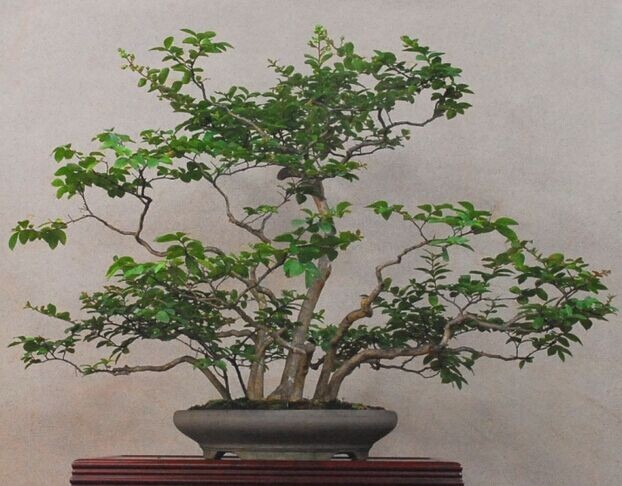
Pruning and shaping:
1. For general pruning and shaping of crape myrtle bonsai, after leaf fall, according to the shaping needs of the bonsai, ordinary branches should be heavily pruned with 1-2 buds retained per branch.
2. Pruning during the growing season mainly removes overly dense branches, sucker branches that disrupt the tree shape, and branches sprouting from the base trunk that have no useful value; all of these should be promptly pinched off or cut away.
3. In order to make crape myrtle bonsai bloom multiple times within a year and bloom well, after each flowering, the spent flowers should be promptly removed to prevent fruit formation and promote the rapid swelling of secondary flower buds, resulting in multiple blooms, but the flowering periods are not uniform enough as they occur in sequence; in addition, after flowering, if there are not many secondary flower buds, keep 1-2 buds per branch for heavy pruning, generally buds appear in 14 days, and in about 35 days the tree can be full of flowers. This can make the branches of crape myrtle bonsai thicker and shorter (average branch length within 15 cm), the tree shape very compact, with abundant flowers and bright colors, pleasing to the eye.
4. Branch bending, branch propping, and branch twisting.
These three techniques are mainly used from May to October, according to the shaping needs of the crape myrtle bonsai, to regulate and control the branches of the crape myrtle bonsai, increase and control the angle of branch positions, and freely adjust the angle and direction of branch positions, so that nutrients are concentrated and nutrients are accumulated. In particular, after some branches of the crape myrtle bonsai are treated with bending, propping, and twisting techniques, some branches become bow-shaped, and on the back of the bow shape, multiple very short small flowering branches (within 10 cm) grow. In this way, not only is the number of flowering branches and flower buds greatly increased, but the color of the crape myrtle flowers is also very bright and beautiful.