What are the fertilization precautions for pine bonsai?
A few days after applying organic fertilizer, white mycelium can often be seen growing on the fertilizer, which most people assume means the fertilizer was not fully composted. After the raw materials are composted, they become powdery. For certain reasons (possibly bagging, ease of application, appearance…etc.), manufacturers make the fertilizer into granules. During this process, sticky substances (such as starch, plant gum and the like) are added, mixed with water and stirred into a fluid so it can be easily shaped by machine, then finally dried at high temperature and sterilized before being bagged, stored and sold.
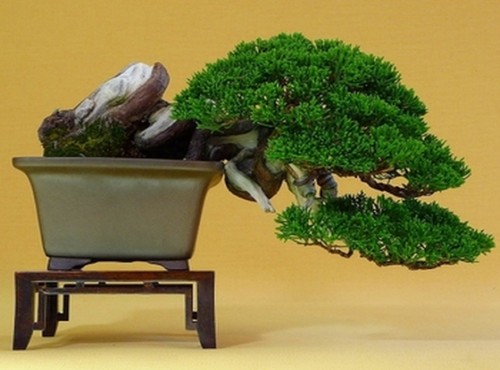
After we apply it, the fertilizer's moisture content increases, and since there is also food inside, once it comes into contact with air and soil microorganisms, the microorganisms multiply massively, producing plenty of mycelium visible to the naked eye. Will this phenomenon harm the plants? As long as the fertilizer layer is not too thick, so that the temperature does not rise sharply, there will be no effect. This process actually speeds up the breakdown of the fertilizer, letting the nutrients and organic matter enter the soil for the plants to absorb.
If organic fertilizer is spread directly on the soil surface, moisture evaporates easily, microorganisms are easily killed by ultraviolet light, the fertilizer breaks down slowly, the plants absorb it slowly, and it will also attract some insects. So you can slightly turn over the soil, apply the fertilizer and then cover it back with soil, letting microorganisms multiply massively and quickly decompose the sticky substances that were added later, speeding up the breakdown rate of the organic fertilizer, and it is also less likely to attract insects (which spread bacteria and viruses).
Nitrogen deficiency: the plant is stunted, the whole plant's leaf color is pale green, old leaves turn yellow and withered… Excess: the plant grows too vigorously, leaf color is deep green, leaves are large and weak… and it is easily infected by pests and diseases.
Phosphorus deficiency: the plant's growth is hindered, leaf width narrows, leaves are smaller, leaf color is dark green and lusterless, and in some crops the old leaves and stems take on a purple color… Excess: the plant becomes shorter, leaves become thick and fleshy, and growth deteriorates.
Potassium deficiency: growth is hindered, the content of water-soluble carbohydrates and soluble nitrogen increases while protein and starch content decreases, the tips of the leaf margins of old leaves turn yellow, the leaf margin mesophyll shows scorched brown spots, the plant is weak and wilts easily when short of water, new leaves turn dark green, elongation is inhibited and they become small leaves, root elongation is poor and the roots rot easily.
Although the pine is a foliage plant, it does not need large amounts of nitrogen fertilizer. After all, the requirement of bonsai is a balance among roots, trunk, branches and leaves. Too much nitrogen fertilizer easily causes leggy growth, overly long leaves and internodes, and a weak, feeble plant, which overall looks very unattractive (especially for a finished tree). Moreover, pine mycorrhiza is a non-leguminous nitrogen-fixing symbiotic fungus; without applying nitrogen fertilizer, pine mycorrhiza can also convert nitrogen gas from the air into nitrogen fertilizer that the plant can absorb (it is unknown whether pine mycorrhiza has phosphate-solubilizing properties). Excess: causes calcium and magnesium deficiency.
Because most of what we use is organic fertilizer, there will be no problem of deficiency in the secondary elements (Ca, Mg, S) and trace elements that other plants need. What needs more attention is the issue of organic matter content. Part of organic matter is humic acid.
Humic acid is classified under the fertilizer category, but its main function is not to supply elements for "pure growth"; rather, it has a special empowering effect, especially on the root system.