How to Fertilize Pine Bonsai? A Detailed Guide to Fertilizing Techniques in Spring and Autumn
In the wild, pines mostly grow in barren or high-altitude areas and are heliophilous (sun-loving) pioneer tree species, which means pines do not need much fertilizer to grow well. In horticultural cultivation, however, fertilizer is still applied to make the trees grow quickly and shorten the cultivation time, especially for us amateur growers, who spare no fertilizer and wish the tree would grow an inch overnight.
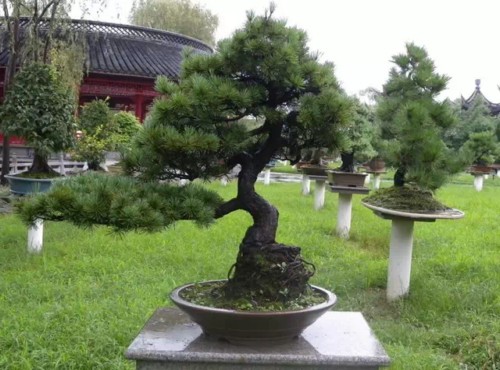
Pine bonsai are generally fertilized twice a year (finished trees may even receive only autumn fertilizer, but when practicing the short-needle method it is best to also fertilize before bud pruning to promote new bud growth).
Spring fertilizer: mainly for growing buds and leaves
Trees with weak vigor can be fertilized a little earlier, after the buds begin to move, around February to March. Since the tree is weak, you cannot and need not apply too much fertilizer at once.
Trees with strong vigor should be fertilized a little later, after leafing out but before bud pruning, around March to May; too early tends to cause leggy growth or overly long internodes. Although overly long internodes can be shortened by bud pinching (or pruning), if the growth is too vigorous and direct sunlight is insufficient, new buds may not begin to leaf out until they have grown to 10~750px or more, because pines only produce buds where there are terminal buds (at the leaf base), and this stretch has no leaves at all to force buds from, so the internodes cannot be shortened, and in the end the entire branch has to be cut off (or all the green buds removed) and started over (this situation is often seen in flower markets: if a stretch of trunk is very long with no leaves, then presumably all the branches that grew during the same period have the problem of overly long internodes).
Autumn fertilizer: mainly for thickening the branches and trunk
Late summer and early autumn, around August to September, when the weather begins to cool and pines start growing rapidly again after their summer dormancy. Generally speaking, autumn fertilizer is a must; if fertilizer is not absorbed sufficiently in autumn, new bud growth will be poor the following spring, affecting the growth vigor for the whole year.
When summer temperatures are too high and sunlight is strong, and winter temperatures are low and sunlight is weak, pine growth slows (cells that grow in summer are the same size as, or even larger than, those that grow in spring and autumn, so the slow summer growth cannot be seen from the annual rings), and (too much) fertilizer is not needed, especially under full sun in summer, when water evaporates quickly; if too much fertilizer remains in the potting soil, the evaporation of water may greatly increase the concentration of ions (fertilizer) in the water, causing fertilizer burn. Even if it does not reach the level of fertilizer burn, the problem of osmotic pressure will reduce the plant's ability to absorb water, diminishing the effect of transpiration, on which pines especially rely to cool down when temperatures are high.
After repotting, it is best to wait 1~2 months before fertilizing; if you miss the timing, just wait until next time, as missing one fertilization is not a big deal (if the pot was only lifted out without removing the soil, you can fertilize one week later in line with the spring or autumn fertilization timing, but do not overdo it, as that would affect the extension of new roots).