What are the correct methods for correcting bonsai roots?
The longer a bonsai is grown in a pot, the more beautiful its root base becomes, so the age and antiquity of a bonsai tree can be judged from its root base. To create a bonsai with a good root base, use a shallow pot, pile the soil slightly higher than the pot rim, let the roots straddle the mounded soil, barely exposed above the soil surface, spreading out in all directions, and exposed to sunlight to accelerate their growth and transformation. If creating from seedling material, you can grow it in a pot for one year and plant it in the ground for one year to shorten the creation time.
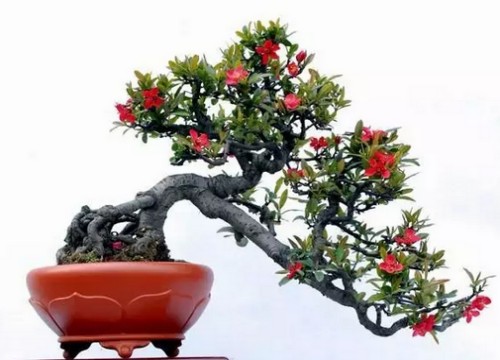
Undesirable roots should be cut off and corrected as early as possible, because the growth of undesirable roots and undesirable branches is closely related. In a bonsai with evenly spread roots, the tree's vigor above ground will also be even, and only then will the branches, buds and leaves of the bonsai tree be neat and beautiful.
Methods for correcting roots:
1. Curved roots, coiled roots and tangled roots, vertical roots, etc., can be cut off, or adjusted using wire, small stones or bamboo strips. Especially vigorously growing running roots should be cut short in advance so they regenerate fine roots and the roots grow evenly; it is best to cut them at the point where fine roots already exist.
2. If roots are insufficient, you can tear open downward roots, or layer a branch near the root base to root and make up the deficiency, or tear open thick roots.
3. Air layering can be used to take a branch in the air and re-form roots.
4. Let the roots be exposed above the ground and exposed to sunlight, so they thicken more easily.
5. Use the root grafting method or approach-graft seedlings; a tree with one-sided roots can be approach-grafted into a double-trunk or multi-trunk form, or you can directly graft roots or approach-graft seedlings to make up the deficiency, or place an elegant stone at the rootless part; for floating roots you can also insert an elegant stone into the gap.
6. You can use the knife and awl stimulation method: at the part of the root base lacking roots, use a knife or awl to remove the epidermis and cambium, exposing the xylem, cover the wound with sphagnum moss and then cover with soil; cultivating a vigorous branch above the wound can promote rooting, and especially when combined with this method on mountain-collected material, it can create a beautiful root base.