How to thin leaves and shape a bonsai? A full breakdown of methods and techniques
Cutting off the leaves at the tips of branches is called “leaf thinning.” Besides preventing branches from growing leggy and promoting the sprouting of axillary buds, leaf thinning also allows the entire tree to receive even sunlight, makes the branches near the roots thicker and the branches in the canopy thinner, so that the tree's vigor becomes strong and healthy. If sunlight cannot easily penetrate, causing poor air circulation, the branches and leaves in the lower part of the potted tree will weaken, the buds will also become small, causing the tree's vigor to gradually decline and branches to wither and become deformed. When thinning leaves, for weak buds leave one third of the leaves; for tree species with opposite buds, in order to change the direction of growth, a single leaf may be left. So pay attention at ordinary times, do not let the leaves become too dense, and frequently remove leaves to make new buds grow out and speed up metabolism.
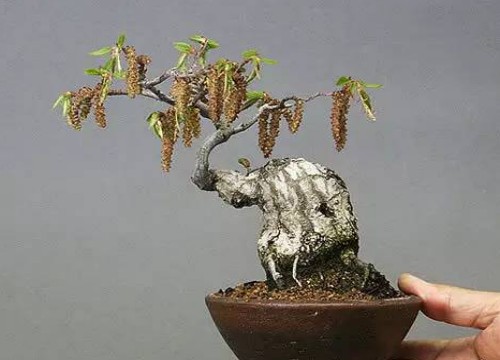
Leaf thinning and shaping in early summer
During the plum rain season, temperature and humidity are suitable, and bonsai trees grow vigorously. Make full use of this period to carry out leaf thinning and shaping on bonsai trees
Purpose and effect of leaf thinning: maintain the balance between the upper and lower branches, protect the weak buds at branch points, make the internodes smaller, produce more branches, and make the leaves finer.
Leaf thinning methods:
Tree species differ, tree growth vigor differs, and the handling methods also differ.
1. Fertilizing before leaf thinning
Fertilizing with a fertilizer applicator
Direct fertilizing
2. Leaf thinning is carried out after the tree's growing points stop growing, generally from late May to late June!
3. After the growing points stop growing, leaf thinning can be carried out (late May to late June).
For old trees, thin out the large outer leaves, and also thin out unnecessary axillary branches; thin and cut the outer leaves, the leaves of weak branches need not be thinned, and thin out unused axillary buds.
5. After leaf thinning, the tree usually needs to be shaped with aluminum wire
Front view before shaping
Oblique front view
6. An unshaped tree is shaped with aluminum wire all at once
Generally the leaves at the ends of branches need not be thinned; leaving them is beneficial to the tree's growth
Front view
Oblique front view
Because deciduous trees grow very fast, the aluminum wire must be removed early, otherwise there will be marks like those in the photo
Branch correction with aluminum wire
Deciduous trees generally use aluminum wire, while pines and cypresses generally use copper wire
1. The aluminum wire is generally wound at 45 degrees to the branch
2. The aluminum wire should be wound in the direction in which the branch is to be corrected
As shown in the figure, this branch needs to be corrected to the right, so the aluminum wire is wound to the right
This place needs to be corrected to the right with aluminum wire
Wind the aluminum wire with a rightward rotation
3. Where a branch is corrected to bend, the aluminum wire must be pressed tightly against the branch's stress point, so that the branch will not break during correction
The stress point of the corrected part
The reserved bud point