What pruning principles should be followed at different stages of a cherry bonsai?
A potted cherry is a miniaturized cherry orchard. It lets you enjoy the beautiful sight of branches full of blossoms and heavy with fruit, and also offers fine fruit to taste after admiring it. In recent years, along with the improvement of potted cultivation techniques, it is gradually making its way onto the balconies and into the courtyards of countless households.
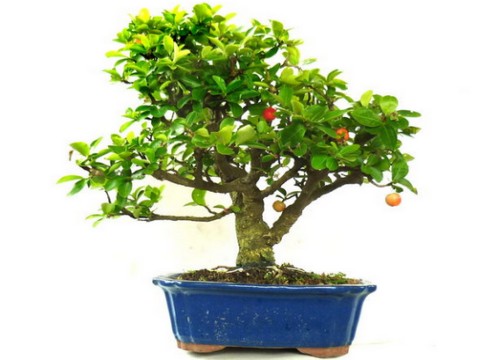
In principle, pruning of cherry bonsai is mainly carried out during the growing season, but due to the constraints of actual production conditions, growing-season pruning is sometimes not done thoroughly, so it needs to be adjusted through pruning before bud break in spring. Pruning before bud break should avoid cutting large branches as much as possible and reduce wounds to prevent gummosis, focusing on thinning out overly dense branches and competing branches, with few heading cuts. Pruning is generally required to be finished before March 10. The pruning principles for cherry bonsai at different stages are:
1. For young trees, thin out the excessively vigorous upright main branches on the central leader and the excessively vigorous water sprouts on the main branches; for the main branches retained and the lateral branches on the main branches, focus on bending branches to open the angle and on notch budding. The opening angle of main branches should preferably be 60—70 degrees, and the opening angle of lateral branches should preferably be 70—80 degrees. When bending branches, they should be pulled into a straight line, and by no means into a bow shape. Notch budding is generally carried out in early March before the buds break, on the main branches, for the purpose of promoting lateral branches.
2. For trees in the initial fruiting stage, 4—7 years old, it is necessary to adjust the tree structure and pay attention to cultivating fruiting branch groups on the main branches. First, gradually thin out main branches that are too low and too dense, so that the main branches do not affect one another; second, appropriately retract branches that have no branching to promote branching. Third, retract or head back overly weak lateral branches to rejuvenate them, and for overly vigorous ones, open the angle to moderate the growth vigor and promote flower formation.
3. For trees in the full fruiting stage, adjust the tree structure well and improve the light and air conditions within the canopy. Excess upright branches, overly dense branches, overlapping branches, crossing branches and the like that sprout within the canopy must be resolutely thinned out, and the spacing between layers should be opened up so as not to disrupt the tree shape and consume nutrients. If the tree is too tall, drop the top and open the center in time, using a weak branch as the leader to control the height of the canopy.