What are the layout methods for forest bonsai? A detailed guide
The layout of forest bonsai is extremely important; it is the key to the success or failure of creating a forest-style bonsai. Several trees that have undergone soil removal are arranged in the pot on a trial basis, and through observation, deliberation, and adjustment of the trees' positions, you achieve a clear distinction between primary and secondary, appropriate spacing and density, and varying heights; between the trees there is a proper degree of yielding and contending, mutual accommodation, forming a graceful layout.
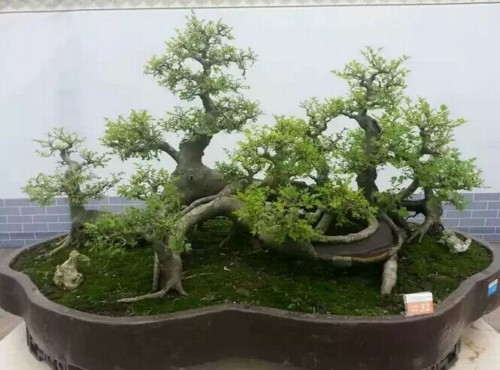
Forest bonsai must have a woodsy feel; the trunks must be arranged with some in front and some behind, and the foliage pads must also be positioned front and back, so that the forest has a sense of deep seclusion. Among the common plants that can be made into bonsai, a single-root multi-trunk forest specimen is generally a gift from nature; artificial cultivation takes a long time and is difficult.
When laying out, first determine the position of the main tree, then consider the positions of the secondary tree and the companion tree. The main tree should be placed about 1/3 of the way to the left or right of the pot, slightly toward the front or back, and should not be in the exact center or at the edge of the pot. In the exact center it is too rigid, and at the edge it appears unstable. The secondary tree is on the other side of the main tree, at a greater distance.
The companion tree is beside the main tree, at a closer distance. If you connect the planting points of the three trees, they should form a scalene triangle. Using three trees as the basis, planting multiple trees together involves flexible variation on the three-tree foundation, and you should try to avoid having three trees in a straight line.
For forest-style bonsai, an odd number of trees is preferable. Before planting, you should try placing them in the pot several times, striving to put each tree in the best position. When planting multiple trees together, pay attention to handling the relationships between primary and secondary, sparse and dense, empty and solid, high and low, far and near, dynamic and static, exposed and hidden, contending and yielding, striving to achieve clear primary and secondary roles, proper spacing and density, uneven heights, and a suitable balance of dynamic and static, with both exposure and concealment. The work must have a strong sense of overall unity, being both harmonious and unified while also rich in variation.