Detailed Explanation of the Key Techniques for Styling Chinese Holly (Ilex cornuta) Bonsai
Chinese holly (Ilex cornuta) has dense branches and leaves, a graceful tree form, and a spreading crown; it is an excellent species for tree planting and afforestation, and is also a good material for making bonsai, with very high ornamental value. If placed in the home, it can effectively enhance the quality of the living space. The price range of Chinese holly trees is quite wide, which is closely related to their size.
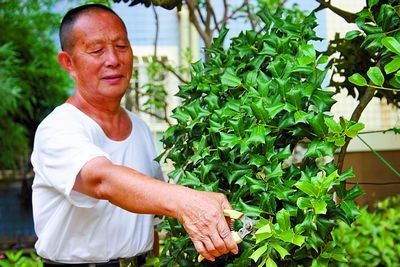
The branches of Chinese holly are hard and brittle, so processing is usually carried out during the plum rain season, when the sap flows vigorously. Because the leaves of Chinese holly are hard and have sharp spines, during styling the unnecessary branches and leaves can be cut off first, and the remaining branches and trunk can then be wired and pruned. The tree form of Chinese holly can be made into styles such as the upright-trunk style, slanting-trunk style, curved-trunk style, and cascade style. Small bonsai are best made in the natural style, while large bonsai can have their branches and leaves trained into cloud-like pads; old stump specimens are presented in the beautiful forms of the exposed-root style and the twisted-trunk style.
After the Chinese holly has survived, styling can be carried out from May to July, and according to the specific shape of the stump, it can be processed into various forms of bonsai such as the lying-trunk style, waterside style, slanting-trunk style, curved-trunk style, and cascade style.
The styling of the crown should depend on the variety. For the common large-leaved Chinese holly and the spineless Chinese holly, because their leaves are relatively large, an elegant natural style can be adopted, with only slight wiring, pulling, and pruning, so that the leaves, branches, and crown are properly spaced and well arranged.
For small-leaved Chinese holly, because its leaves are small and dense, it can be processed into regular round pads or wired into a natural form. A well-made Chinese holly bonsai can be moved into a display pot for viewing in the spring of the following year; the potting soil should be well-drained, fertile, and slightly acidic.