How to water a yew (Taxus) bonsai? Remember: don't water until dry, and when you do, soak it thoroughly
Water is an important component of the body of flowers and trees, and all life activities of flowers and trees must be carried out with the participation of water. Whether it is photosynthesis or transpiration, water is indispensable. Water can maintain the turgor pressure of cells and keep branches and leaves upright. But beyond the limit, the plant's growth becomes weak instead. If the potting soil contains too much water for a long time, it will cause the leaves to turn yellow, fall off, root rot, and even death.
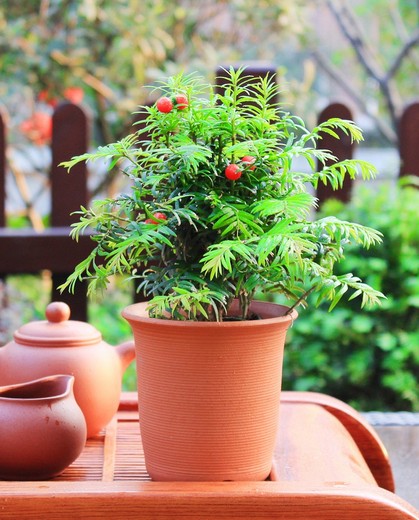
1. Observe the surface of the potting soil: when the color slightly becomes lighter, the leaves are slightly curled, pressing the potting soil with a finger feels somewhat soft, and tapping the upper middle part of the pot body with a finger joint produces a rather dull sound, there is no need to water the potting soil; just spray the leaf surface to supplement the leaves' moisture. When the soil surface turns white, pressing with a finger feels rather hard, a ring of cracks appears between the pot and the soil, tapping the upper middle part of the pot body with a finger joint produces a crisp "bang bang" sound, and the new shoots and young leaves wilt, the potting soil should be watered.
Before watering, the cracks between the soil and the pot should be pressed firm with a hard object, then water. Use a large ladle to water; when pouring, the ladle should be close to the pot rim, pour the water in all at once, and soak it thoroughly in one go so that the potting soil absorbs enough water. If a small amount of water is poured into the pot and water is seen flowing quickly out from the bottom of the pot after a moment, it means the soil and the pot are not completely pressed firm, and an object should be used to press the gap between the pot wall and the soil tight before watering. When the potting soil structure is normal, it is best if water slowly seeps out from the bottom of the pot about 40 seconds to one minute after watering.
The water temperature for watering must be close to or consistent with the air temperature at the time. When using tap water, the water should first be placed in the sun for about three hours before watering, because light helps decompose oxides in tap water and can raise the water temperature. The water can also be placed in a large basin for half a day or one night before watering. If there are many bonsai, it is best to put the water in a large vat so that the water temperature is as close as possible to the air temperature and soil temperature. Especially in hot seasons, besides watering the potting soil, water mist should also be sprayed on the leaf surface to keep the leaves moist, which is beneficial to growth; the potting soil can be kept slightly dry and must not be too wet. When there are many pots, each pot must be checked according to the actual situation, taking care not to miss watering or overwater.
2. Yew leaves are evergreen all year round and are suitable for placing indoors. But a yew bonsai should not be placed at the air outlet of an air conditioner, otherwise the water evaporation from the yew leaves will increase, easily causing the yew branches and leaves to dehydrate quickly, making the leaves curl and dry up. If placed in an air-conditioned room where the air conditioner is turned on every day, spray the leaf surface every day to keep the leaves humid, and place a basin of clean water indoors.
If in a room with heating in winter in the north, it should be kept farther from the radiator, and a basin of clean water should be placed on the radiator to increase the indoor air humidity. In summer and autumn, when the temperature exceeds 30 degrees Celsius, shading and cooling work should be strengthened, and it can be moved to a ventilated room facing north. If necessary, water can be sprayed to lower the temperature, creating a cool and humid environment to benefit the growth of the yew. Also avoid rooms where direct west-facing sunlight shines directly on the yew bonsai.
In winter, the amount of watering for the bonsai should be controlled to avoid the potting soil being too wet for a long time. Since the plant's growth is not vigorous in winter and the leaves evaporate less water, if the potting soil is too wet for a long time, the surface of the potting soil will become compacted and impermeable, easily causing root rot in the plant. When raising yew indoors, be sure to pay attention to more indoor ventilation.
3. The soil for planting yew should be loose, rich in humus, fertile, and slightly acidic (PH=5.5 to 7). Do not pour tea water into the yew bonsai. If leftover tea water is often poured in, because the tea water contains theophylline and other plant alkalies, it will change the soil's pH and also have a relatively destructive effect on the organic nutrients in the soil.
It inhibits the growth of the yew and will also cause excessive soil humidity, hindering the potting soil's permeability and causing root rot and stem rot. If conditions permit, about once a week, move the yew bonsai to the balcony at night to receive dew, and in the morning place it in the sun for about one or two hours to receive light (before ten o'clock in the morning), which is beneficial to the growth of the yew and improves disease resistance. In summer and autumn, prevent direct west-facing sunlight from shining through the window directly on the yew, to prevent high temperatures from scorching the leaves and affecting the ornamental value.