What are the fertilization methods for yew bonsai?
The yew (Taxus) is a tree species with a very wide range of uses, and it is also known as the “living fossil of the plant kingdom,” which shows just how long it has survived. The high-grade bonsai made from yew trees uses the Northeast yew (Taxus cuspidata) treated with dwarfing techniques; the resulting bonsai has a simple and elegant form, with compact but not crowded branches and leaves, and has very high ornamental value. Although the yew is so precious, the price of yew is not expensive.
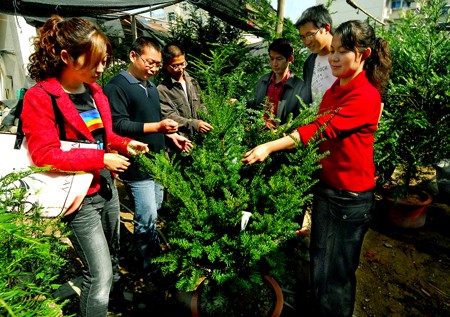
The three key elements of plant growth are nitrogen, phosphorus and potassium fertilizers. Nitrogen fertilizer can promote the growth of flowers, branches and leaves; phosphorus fertilizer can promote the formation of flowers and fruits; potassium fertilizer can promote the growth of stems and roots. Because bonsai are grown in the limited space of a pot and in limited cultivation soil, organic matter is decomposed by bacteria into inorganic salts that are absorbed by the roots. As the yew grows and consumes nutrients, the nutrients in the potting soil gradually become deficient, so that they are no longer sufficient to supply the needs of growth.
Although the bonsai uses a prepared nutrient soil, do not fertilize within three months after purchase. Just water with about a 1000-fold potassium dihydrogen phosphate solution or spray it on the leaves every seven to ten days in the evening.
Control the amount of watering well; do not water too much. Only when the leaf color becomes pale, the plant is thin and weak, the leaves turn yellow-white, and “scorched edges” appear at the leaf margins and tips, and the leaves age prematurely and drop, apply a 1000-fold urea solution or an 800-fold quick-dissolving high-quality compound fertilizer solution of potassium sulfate, remove the sediment, and water the potting soil with it, applying it about once a month. It is best to use fully rotted dilute soybean cake fertilizer water (about 10%-15%); when applying, avoid the trunk area and apply as much as possible along the pot wall, once every half month.
The next day after fertilizing, water once more with clear water to prevent the fertilizer from being too concentrated by diluting it. The above two fertilizers can be used alternately, or you can dig two small holes in each pot and put five or six granules of urea and seven or eight granules of high-quality compound fertilizer in them. Then cover with soil and water so the fertilizer dissolves. Yew bonsai should avoid raw fertilizer and concentrated fertilizer. Topdressing should be mainly nitrogen and phosphorus fertilizer, and must not be too concentrated.